

Key Takeaways
- Understand the key distinctions between aluminium tubes and pipes for accurate application selection.
- Aluminium tubes are specified by outside dimensions and wall thickness, while pipes use nominal sizes.
- Applications of aluminium tubes include structural frameworks, automotive components, and heat exchangers.
- Consulting an Aluminum Tubes Manufacturer ensures you get the right specifications for your project needs.
- Selecting the right shape and alloy is crucial for the intended functionality of aluminium products.
Kalp Alloys is a leading manufacturer and exporter of aluminium tubes and related aluminium products. In industrial applications, the terms tube and pipe are often used interchangeably, but they can have different meanings when it comes to dimensions, sizing methods, applications, and specifications. For buyers working with an Aluminum Tubes Manufacturer, understanding these differences can help in selecting the right product for a particular engineering requirement.
What Is an Aluminium Tube?
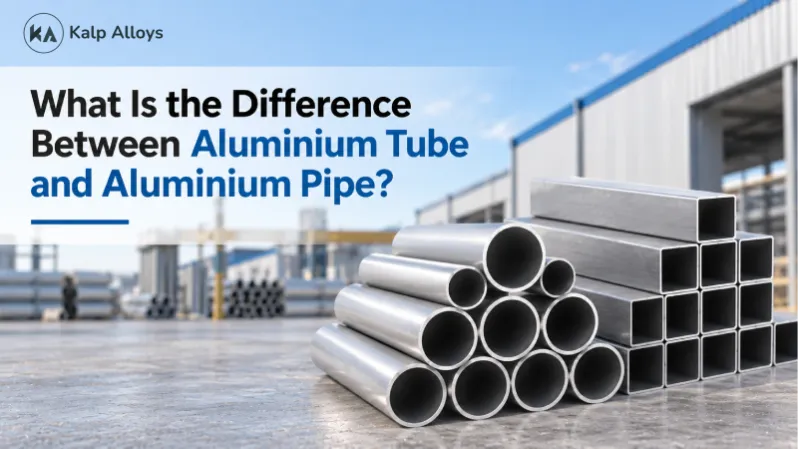
An aluminium tube is a hollow aluminium product available in different shapes, wall thicknesses, and dimensional configurations. Tubes can be round, rectangular, square, or other formed profiles depending on the manufacturing process and intended application.
Unlike pipes, tubes are commonly specified using their outside dimensions and wall thickness. This makes aluminium tubing useful when accurate dimensional control and structural performance are important.
Aluminium tubes are widely used in fabrication, engineering, transportation, construction, heat transfer equipment, and other applications where lightweight and corrosion-resistant materials are required.
What Is an Aluminium Pipe?
An aluminium pipe is also a hollow cylindrical product, but the term pipe is generally associated with products used for conveying fluids, gases, or other materials. Pipe dimensions are commonly associated with nominal pipe sizes and standardized schedules or wall thickness classifications, depending on the applicable specification.
The distinction is therefore not simply based on whether the product is hollow. The intended application, dimensional standard, and method of specification are also important.
The main difference between an aluminium tube and an aluminium pipe often comes down to how the product is specified and where it is intended to be used.
Aluminium Tube vs Aluminium Pipe: Key Differences
For a quick comparison, the following table highlights the major distinctions:
| Factor | Aluminium Tube | Aluminium Pipe |
|---|---|---|
| Typical shape | Round, square, rectangular, and custom profiles | Usually circular |
| Dimension reference | Commonly outside diameter and wall thickness | Often nominal pipe size and wall thickness |
| Main applications | Structural, fabrication, engineering, heat transfer | Fluid, gas, and process transfer applications |
| Design focus | Dimensional accuracy and structural requirements | Pressure or flow-related requirements where applicable |
| Selection basis | Shape, dimensions, alloy, temper, and application | Nominal size, wall thickness, alloy, and service requirements |
These differences are general industry distinctions, and actual specifications can vary depending on the standard, alloy, manufacturing method, and end use.
Why Are Aluminium Tubes Used in Industrial Applications?
Aluminium tubes are selected for many engineering applications because aluminium combines low density with useful mechanical and corrosion-resistant properties. Its ability to be manufactured into different shapes also makes it suitable for a broad range of designs.
Common applications include:
- Structural frameworks and supports
- Automotive and transportation components
- Heat exchanger and thermal applications
- Furniture and architectural fabrication
- General industrial assemblies
- Equipment and machinery components
For these applications, buyers often need a product with specific alloy, temper, dimensions, wall thickness, and surface requirements.
Why Are Aluminium Pipes Used?
Aluminium pipes can be suitable where a hollow cylindrical product is needed for conveying or transferring materials. Depending on the engineering requirements, pipe selection may involve considerations such as internal diameter, wall thickness, pressure conditions, temperature, and compatibility with the conveyed medium.
The actual service environment is important when selecting an aluminium pipe. A product appropriate for a general fabrication application may not be appropriate for a particular fluid-handling requirement.
This is why specifications should be confirmed before purchasing rather than selecting a product based only on the words "tube" or "pipe."
How Are Aluminium Tubes and Pipes Specified?
One of the most important differences for industrial buyers is the way dimensions are described.
An aluminium tube is often identified by its outside diameter and wall thickness. For rectangular and square tubes, dimensions may be given by width, height, and wall thickness.
Pipe sizing may instead use a nominal pipe size along with a specified wall thickness or schedule under the relevant standard.
When requesting products from an Aluminum Tubes Manufacturer, buyers should provide complete dimensional requirements rather than simply stating the required tube diameter.
The material specification should also be considered. Important details may include:
- ✔ Aluminium alloy grade
- ✔ Temper or heat-treatment condition
- ✔ Outside dimensions
- ✔ Wall thickness
- ✔ Length
- ✔ Surface finish
- ✔ Applicable product standard
- ✔ Quantity and application
Providing these details reduces confusion during product selection and quotation.
Does the Shape Make a Difference?
Yes. The shape can be a major factor in choosing between tube and pipe products.
Round aluminium tubes are useful for many structural and mechanical applications, while square and rectangular tubes can provide convenient geometry for frames and fabricated structures.
Pipes are generally cylindrical because their design is commonly associated with fluid or gas transfer. However, the exact product definition still depends on the applicable technical specification.
For fabrication and structural projects, tube geometry can be just as important as the aluminium alloy itself.
How Should Buyers Choose Between Aluminium Tube and Pipe?
The right product should be selected according to the function it needs to perform. Instead of starting with the product name, start with the application and required specifications.
A practical selection process is:
- Define the application – Determine whether the product is required for structural, mechanical, fabrication, heat-transfer, or fluid-handling use.
- Identify the required dimensions – Confirm diameter, width, height, and wall thickness as applicable.
- Select the aluminium alloy – Choose the alloy according to the required mechanical and corrosion properties.
- Check the applicable standard – Confirm the required material and dimensional standard.
- Verify the manufacturing requirements – Review length, finish, tolerance, and other project-specific requirements.
- Confirm suitability with the supplier – Share the complete technical specification before placing the order.
This approach makes product selection more precise and helps prevent dimensional or material mismatches.
What Should You Ask an Aluminium Tube Supplier?
When purchasing aluminium tubes, clear technical communication can make the procurement process easier. Ask the supplier about the available alloy grades, dimensions, tolerances, manufacturing process, and applicable standards.
For buyers working with an Aluminum Tubes Exporter, it is also useful to confirm packaging, documentation, shipment requirements, and the exact product specification before finalizing an order.
The supplier should be able to understand your application and provide the product according to the agreed technical requirements.
Why Choose Us
At Kalp Alloys, we focus on supplying aluminium tubes according to the dimensional and material requirements of industrial buyers. We understand that different applications call for different combinations of alloy, temper, shape, wall thickness, and finish. Our approach is centered on clear technical communication and product specifications so customers can select aluminium tubes that match their project requirements. As an Aluminum Tubes Exporter, we also support customers who require aluminium tube supplies for applications across different markets.
Conclusion
Although aluminium tubes and aluminium pipes are both hollow aluminium products, they are not necessarily the same in terms of sizing, specification, shape, and intended use. Tubes are commonly selected based on actual dimensions and can be produced in round, square, rectangular, and other profiles. Pipes are generally associated with cylindrical products used for conveying fluids or gases under defined service requirements.
For buyers, the best approach is to focus on the application, dimensions, alloy, wall thickness, standards, and other technical specifications. Working with an experienced Aluminum Tubes Manufacturer can make it easier to identify the correct product for your specific industrial requirement.
Looking for aluminium tubes for your industrial, fabrication, structural, or engineering requirements? Kalp Alloys can help you discuss the required alloy, dimensions, shape, wall thickness, and product specifications.
For more information about our aluminium tubes and to discuss your requirements with our team, call +91 81608 73937
Email: sales@kalpAlloyscom
Frequently Asked Questions
What is the primary difference between aluminum tube and aluminum pipe?
The main difference lies in their specifications and intended applications. Aluminum tubes are typically defined by their outside diameter and wall thickness, whereas aluminum pipes use nominal pipe sizes and wall thickness classifications. Tubes are generally used for structural and mechanical applications, while pipes are designed for conveying fluids and gases.
What are the common applications for aluminum tubes?
Aluminum tubes are used in a variety of applications including structural frameworks, automotive components, heat exchangers, furniture fabrication, and general industrial assemblies. Their lightweight and corrosion-resistant properties make them ideal for these purposes.
How should buyers choose between an aluminum tube and an aluminum pipe?
Buyers should start by defining the application and required specifications, including dimensions, shape, and alloy. It’s important to verify the manufacturing requirements and discuss technical details with the supplier to ensure compatibility with the intended use.
What specifications should be confirmed when purchasing from an aluminum tubes manufacturer?
Buyers should confirm specifications such as aluminum alloy grade, temper, outside dimensions, wall thickness, length, surface finish, applicable standards, and quantity. Providing complete dimensional and material requirements helps facilitate accurate orders and reduces confusion.
Why is shape an important factor when selecting aluminum tubes or pipes?
Shape affects the product’s suitability for certain applications; for instance, round tubes are often used for structural purposes, while square or rectangular tubes are better for frame fabrication. Pipes, being cylindrical, are primarily associated with fluid transfer, making the shape critical in the selection process.