

Key Takeaways
- 304 stainless steel pipes are ideal for general-purpose applications with moderate corrosion resistance needs.
- 316 stainless steel pipes offer enhanced corrosion resistance, especially in chloride-rich environments.
- Understanding the differences between 304 and 316 grades is vital for selecting the right stainless steel pipes manufacturer.
- Choosing the appropriate stainless steel tube manufacturer ensures compliance with specific application requirements and standards.
- 304 stainless steel pipes are ideal for general applications with moderate corrosion exposure.
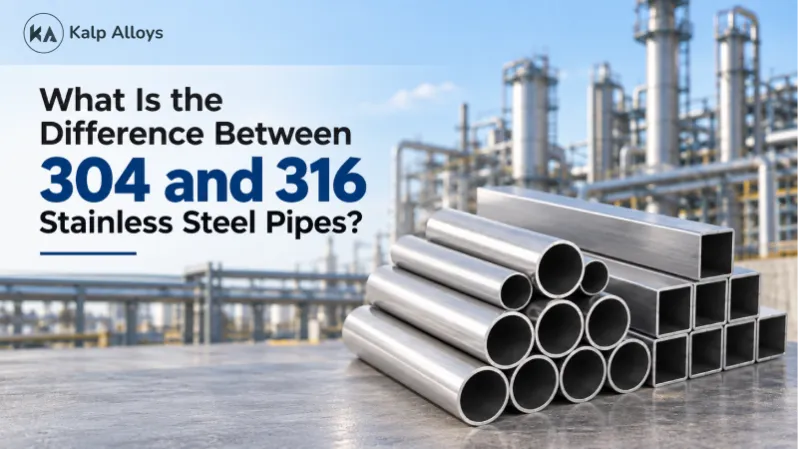
Kalp Alloys is a leading manufacturer and exporter of stainless steel pipes and tubes. Choosing between 304 and 316 stainless steel can have a direct impact on long-term performance, service compatibility, and corrosion resistance for industrial buyers. A reliable Stainless Steel Pipes Manufacturer can help buyers select the appropriate grade based on the working environment rather than treating both grades as interchangeable.
Although 304 and 316 belong to the same austenitic stainless steel family, their chemical compositions and resistance characteristics are different.
What Are 304 Stainless Steel Pipes?
One of the most popular grades of austenitic stainless steel is 304. It contains chromium and nickel as its principal alloying elements and is valued for its combination of corrosion resistance, formability, weldability, and general-purpose performance.
304 pipes are commonly considered for applications where the operating environment is not highly aggressive. They are used across a range of industrial, commercial, food-processing, architectural, and general fabrication applications.
304 is often selected when good all-round corrosion resistance is required without the more specialized corrosion resistance associated with 316.
What Are 316 Stainless Steel Pipes?
In addition to chromium and nickel, 316 stainless steel also has molybdenum, making it an austenitic grade. The presence of molybdenum gives 316 better resistance to certain forms of localized corrosion, particularly in environments involving chlorides.
This makes 316 an important option for applications exposed to marine conditions, salt-containing environments, certain chemical-processing conditions, and other corrosive surroundings.
For buyers working with a Stainless Steel Pipes Manufacturer, the key distinction is that 316 is not simply a different version of 304; its alloy composition gives it different performance characteristics.
304 vs 316 Stainless Steel Pipes
The main differences become clearer when the two grades are compared on the factors that commonly influence material selection.
| Property | 304 Stainless Steel | 316 Stainless Steel |
|---|---|---|
| Basic type | Austenitic stainless steel | Austenitic stainless steel |
| Main alloying elements | Chromium and nickel | Chromium, nickel, and molybdenum |
| Corrosion resistance | Good general corrosion resistance | Higher resistance in many chloride-containing environments |
| Typical environment | General industrial and commercial service | More demanding and corrosive environments |
| Common selection reason | Versatility and general performance | Enhanced corrosion resistance |
The actual suitability of either grade still depends on the operating environment, temperature, fluid, fabrication requirements, and applicable material specifications.
Why Does Molybdenum Matter?
Molybdenum is one of the most significant differences between 304 and 316 stainless steels, providing enhanced protection against pitting and crevice corrosion in environments containing chloride.
It is crucial to point out that stainless steel 316 is still vulnerable to corrosion. All grades of stainless steel cannot be considered as universally protected against any chemical or working conditions.
The inclusion of molybdenum renders stainless steel 316 especially useful where there is any chloride exposure.
Which Grade Offers Better Corrosion Resistance?
In general, 316 provides better corrosion resistance than 304 in environments where chlorides and certain aggressive conditions are present.
For example, applications exposed to seawater, marine atmospheres, or chloride-containing process conditions may require the additional corrosion resistance offered by 316. However, the correct choice should always be based on the specific service conditions rather than on grade preference alone.
A technically experienced Stainless Steel Tubes Manufacturer can help evaluate the application and recommend the appropriate material grade, dimensions, and tube specification.
Where Are Pipes Made of 304 Stainless Steel Frequently Used?
304 is a versatile grade and is suitable for a broad range of applications where severe chloride exposure is not the primary concern.
Typical uses include:
- Food and beverage processing equipment
- General industrial piping
- Kitchen and commercial equipment
- Architectural applications
- Fabrication and manufacturing equipment
- General-purpose fluid handling
304 is a popular material for many typical applications due to its availability, manufacturing qualities, and corrosion resistance.
Where Are 316 Stainless Steel Pipes Typically Used?
316 is often selected when the operating environment places greater demands on corrosion resistance.
Common application areas include:
- Marine and coastal equipment
- Chemical-processing environments
- Pharmaceutical applications
- Certain food-processing environments
- Water and wastewater-related equipment
- Equipment exposed to chloride-containing conditions
The actual material selection should consider the complete service environment, because chemical concentration, temperature, exposure time, and other factors can influence stainless steel performance.
How Do Buyers Select Between 304 and 316?
The application, not the grade designation, should be the first consideration when choosing materials. A structured evaluation can make the decision much clearer.
- Identify the service environment and potential corrosive agents.
- Check whether chloride exposure is expected.
- Review operating temperature and pressure requirements.
- Confirm the required pipe or tube dimensions and specification.
- Consider fabrication, welding, and forming requirements.
- Confirm the material standard and inspection requirements applicable to the project.
This process helps avoid selecting a grade simply because it is commonly used.
For international procurement, working with an experienced Stainless Steel Pipes Exporter can also help buyers clarify material specifications, documentation, dimensions, and shipment requirements before placing an order.
How Do Stainless Steel Pipes and Tubes Differ?
The words "pipe" and "tube" are interchangeably used in informal discussions, although the two may denote different specifications and uses of the products.
While pipes are typically considered fluid/gas conduits, tubes are normally engineered as either structural/mechanical/heat exchanger tubes or precision tubes. Sometimes the difference lies in the dimensional specification of the product in relation to a certain project.
A competent Stainless Steel Tubes Exporter should be able to deliver the desired products based on the required specifications and end use.
Why Does the Right Supplier Matter?
Grade of material is not the only consideration in purchasing stainless steel products. It is also necessary to check product specification, size, manufacturing considerations, quality certification, and the application suitability of the product.
While choosing a Stainless Steel Pipes Manufacturer, it is better to give detailed technical specifications instead of just asking for "304" or "316" pipes. This will allow the manufacturer to determine what is the real application and what are the technical needs.
Similarly, an expert Stainless Steel Tubes Manufacturer will be able to differentiate between standard tubing needs and those where special dimensions, mechanical properties, or surface properties are required.
Why Choose Us
At Kalp Alloys, our efforts are geared towards providing stainless steel pipes and tubes based on the needs of our clients as per their technical requirements. In our company, the starting point is to ascertain the grade needed, its dimensions, and any other specification about the type of stainless steel that will be purchased. We deal with buyers both in the local and international markets who need dependable stainless steel materials for various uses. We can explain to the buyers the difference between 304 and 316 grades.
Conclusion
There are only two major differences between 304 and 316 stainless steel pipes – their alloying elements and consequently their corrosion resistance properties. One can use 304 for most general purposes, but 316 is more suitable for those areas with high content of chloride or when there are more severe corrosion conditions. Always consider the particular operational environment, product needs, and standards while choosing your grade.
If you need assistance in selecting the appropriate materials and products, Kalp Alloys will help you find the right stainless steel pipes and tubes that meet your criteria. It can be useful to select the right grade right from the start.
Looking for a reliable supplier for 304 or 316 stainless steel pipes and tubes? Kalp Alloys can help you discuss your grade, size, specification, and application requirements.
Looking for reliable stainless steel pipes and tubes for your industrial applications? Kalp Alloys can help you discuss your required grade, dimensions, specifications, and project requirements.
For more information about our stainless steel products and to discuss your requirements with our team, call +91 81608 73937
Email: sales@kalpalloys.com
Frequently Asked Questions
What are the main differences between 304 and 316 stainless steel pipes?
The primary differences lie in their alloying elements and corrosion resistance properties. While 304 contains chromium and nickel, 316 includes molybdenum, which enhances its resistance to chloride-induced corrosion. This makes 316 better suited for more demanding environments.
Which grade of stainless steel pipes should I choose for marine applications?
For marine applications, 316 stainless steel pipes are generally recommended due to their superior resistance to corrosion in chloride environments. 304 may not provide adequate protection against the harsh conditions typically found in marine settings.
Why is molybdenum important in 316 stainless steel pipes?
Molybdenum is crucial in 316 stainless steel pipes as it significantly enhances resistance to pitting and crevice corrosion, especially in environments containing chlorides. This makes 316 more reliable in corrosive environments compared to 304.
As a stainless steel pipes manufacturer, how do we determine the right grade for an application?
Choosing the right grade involves evaluating the service environment, potential corrosive agents, operating temperature, and specific project requirements. A stainless steel pipes manufacturer can guide you through this assessment to ensure the most suitable material selection.
What considerations should I keep in mind when selecting a stainless steel tubes exporter?
When selecting a stainless steel tubes exporter, ensure they can meet your specific material, size, and quality standards. Look for an exporter with experience in your industry sector and ask about their compliance with applicable specifications and certifications.