

Key Takeaways
- Titanium tubes offer superior corrosion resistance in aggressive chemical environments compared to conventional steel options.
- As a Titanium Tubes Manufacturer, Kalp Alloys provides various grades tailored for specific applications.
- Understanding the role of titanium grades is crucial for selecting the right tubing for your project.
- Titanium’s strength-to-weight ratio makes it ideal for applications where reducing equipment weight is essential.
- Proper specifications for titanium tubes are key to successful performance in heat exchangers and chemical processing applications.
Kalp Alloys is a Leading Manufacturer of Titanium Tubes.
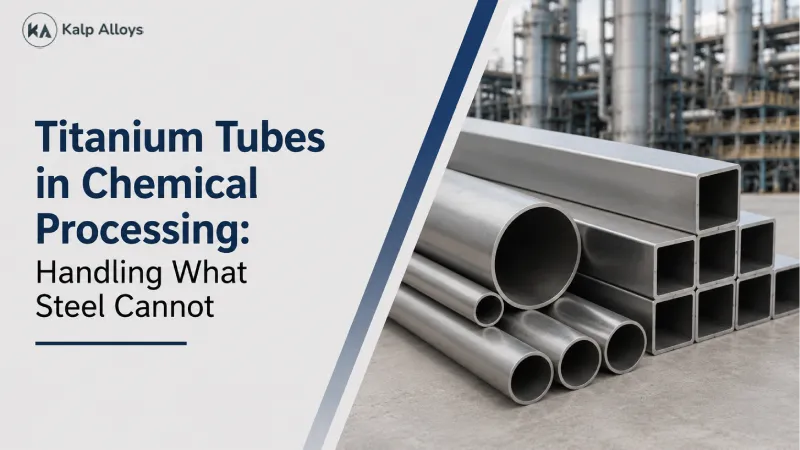
Chemical processing can expose equipment to aggressive chemicals, chloride-containing solutions, moisture, and demanding operating conditions. In such environments, choosing tubing only by conventional material preferences may not be enough. Titanium has become an important engineering option where corrosion resistance and a strong strength-to-weight combination are required.
This does not mean titanium automatically replaces steel in every chemical system. The correct material still depends on the chemical environment, temperature, concentration, flow conditions, fabrication requirements, and project specification. But for selected services, titanium can provide a level of corrosion performance that makes it particularly valuable.
Why Titanium Is Important in Chemical Processing
Titanium is known for its strong corrosion resistance in many environments. This comes largely from a stable protective oxide film that forms naturally on its surface.
That characteristic makes titanium useful in chemical processing, marine systems, heat exchangers, and other applications where conventional metallic materials may face aggressive corrosion conditions.
Titanium also offers a useful strength-to-weight ratio. This can be valuable when designers need a corrosion-resistant material without adding unnecessary weight to equipment.
As a Titanium Tubes Manufacturer, Kalp Alloys lists titanium tubes in Grades 1, 2, 3, 4, 5, 7, 9, and 23, with seamless, ERW, and welded options according to its published product information.
Where Titanium Tubes Are Used in Chemical Plants
One of the most important applications is heat-transfer equipment. Titanium tubes can be used in heat exchangers, condensers, evaporators, and related systems where the tube-side or shell-side environment demands strong corrosion resistance.
ASTM B338 covers seamless and welded titanium and titanium alloy tubes for condensers, evaporators, and heat exchangers. The standard includes multiple titanium grades and specifies requirements covering chemistry, mechanical properties, flattening, and applicable non-destructive and pressure testing.
Depending on the process, titanium tubing may also be considered for:
- Chemical processing equipment
- Chloride-bearing environments
- Heat exchangers
- Condensers
- Desalination systems
- Marine-related process equipment
- Selected pharmaceutical and industrial systems
The actual suitability must always be established against the chemical composition and operating conditions.
Titanium Grades Matter
Not all titanium grades behave in exactly the same way.
Commercially pure titanium grades such as Grades 1, 2, 3, and 4 are available for different combinations of strength, formability, and corrosion requirements. Titanium alloys such as Grade 5 and Grade 9 offer different mechanical characteristics.
Grade selection should take into account:
- Chemical concentration
- Operating temperature
- Pressure and mechanical loads
- Chloride exposure
- Required strength
- Fabrication and welding requirements
- Applicable product standard
A professional Titanium Tubes Exporter should therefore ask for the application and specification before recommending a grade.
Titanium Tubes vs Conventional Steel Tubes
Steel remains an excellent engineering material and is widely used throughout chemical plants. The question is not whether titanium is always better. It is whether titanium is the more appropriate material for a particular service.
Titanium becomes attractive where corrosion resistance is a major design requirement. In the right environment, its corrosion performance can help reduce material degradation and support longer equipment service.
However, titanium has its own fabrication, welding, surface contamination, and material-handling considerations. It should be selected by engineers based on the complete operating environment rather than a single property.
What to Check Before Buying Titanium Tubes
Before you buy titanium tubes, prepare a clear technical specification. A supplier will need more than simply the required outside diameter.
Important information includes:
- Titanium grade
- Seamless or welded construction
- Outside diameter and wall thickness
- Tube length
- Heat-treatment condition
- Applicable ASTM or ASME specification
- Testing requirements
- Surface and finish requirements
- Quantity and documentation requirements
ASTM B338, for example, contains specific test requirements for both seamless and welded titanium tubing.
This level of detail is especially important for heat exchanger projects, where tube dimensions, cleanliness, material condition, and testing can influence fabrication and operation.
Why Choose Us
At Kalp Alloys, we concentrate on offering titanium and other engineering alloys for industrial use. The various tubes of titanium which we publish consist of several grades of commercially pure and alloy, including seamless, ERW, and welded type of construction for industrial purposes. We help our customers comprehend the grade, size, purpose, and specifications before creating the products. Being a Titanium Tubes Manufacturer, we try to keep the technical sourcing simple, whereas our Titanium Tubes Exporter position helps us support our customers who have needs on a national and international level.
Conclusion
Titanium tubing is significant in chemical processes since they offer good corrosion resistance coupled with favorable weight-strength ratio. They are specifically applicable in certain heat exchangers, condensers, evaporators, chemical equipment among others that operate in difficult environments. Titanium must not be seen as a substitute for steel in any environment. Such factors as grade, composition, temperature, pressure, dimensions, fabrication process, welding, among others, affect material selection. There exists ASTM B338 which gives specifications of titanium tubing for condensers, evaporators, and heat exchangers. In difficult environments, good specification is key in selecting appropriate titanium tube.
Need titanium tubes for chemical processing, heat exchangers, condensers, or industrial applications? Contact Kalp Alloys at +91 8160873937 or email sales@kalpalloys.com for product information and enquiries.
Frequently Asked Questions
What are the advantages of using titanium tubes in chemical processing?
Titanium tubes offer exceptional corrosion resistance and a favorable strength-to-weight ratio, making them ideal for harsh chemical environments. Their inherent protective oxide film allows them to withstand aggressive chemicals, reducing material degradation and supporting longer service life compared to conventional materials.
How do titanium tubes compare to steel tubes in chemical applications?
While steel is widely used in chemical plants, titanium tubes become more advantageous in situations where corrosion resistance is critical. In specific environments, titanium can significantly outperform steel, but the choice between them should be based on detailed operational requirements.
What specifications should I consider when purchasing titanium tubes?
When buying titanium tubes, it’s essential to specify the titanium grade, construction type (seamless or welded), outside diameter, wall thickness, tube length, and any applicable ASTM or ASME specifications. Providing detailed requirements helps ensure you receive the most suitable product for your application.
What is ASTM B338 and why is it important for titanium tubes?
ASTM B338 outlines the standards for seamless and welded titanium and titanium alloy tubes specifically for heat exchangers, condensers, and evaporators. It ensures that the tubes meet the chemical, mechanical, and testing requirements necessary for reliable performance in challenging environments.
Why choose Kalp Alloys as a titanium tubes manufacturer?
Kalp Alloys focuses on providing high-quality titanium and engineering alloys tailored for industrial applications. With various grades and tube constructions available, we help customers navigate their specific requirements, ensuring they receive the right solutions for their chemical processing needs.