

Key Takeaways
- Specify the titanium grade to ensure the correct material properties are evaluated by the Titanium Tubes Manufacturer.
- Include tube dimensions like outside diameter and wall thickness for accurate manufacturing assessment.
- State the required tube length clearly to avoid ambiguities and ensure compliance with design specifications.
- Define whether seamless or welded construction is needed, guiding the manufacturing process effectively.
- Mention applicable standards and documentation requirements to streamline the procurement process with the Titanium Tubes Exporter.
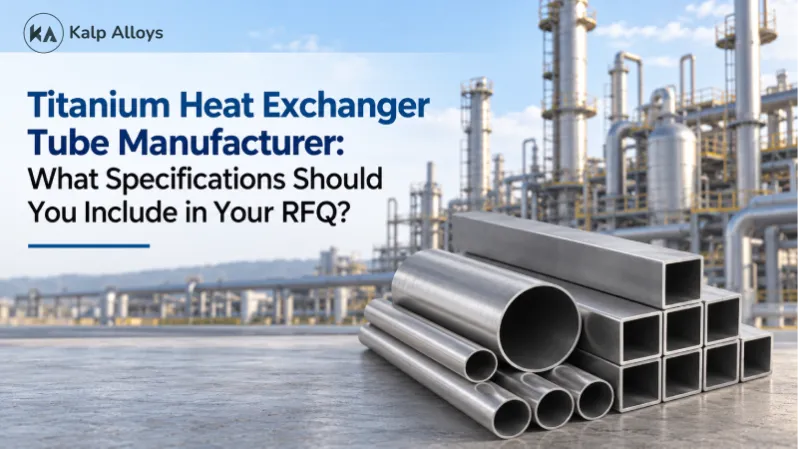
Kalp Alloys is a leading manufacturer and exporter of titanium tubes. When buying titanium heat exchanger tubes, a detailed RFQ helps suppliers understand exactly what your application requires. A good specification sheet should cover material grade, tube dimensions, manufacturing type, standards, testing, finish, and delivery requirements. For buyers approaching a Titanium Tubes Manufacturer, providing complete technical information from the start can reduce clarification cycles and make quotation comparison much easier.
Why Does a Detailed RFQ Matter for Titanium Heat Exchanger Tubes?
Titanium tubes may be used in demanding heat transfer environments where material selection and dimensional accuracy are important. However, the right tube cannot be identified from the material name alone.
A request that simply says “titanium heat exchanger tubes required” leaves several important details open. The supplier still needs to know the grade, dimensions, quantity, tube length, applicable standards, and inspection requirements.
A technically complete RFQ gives the manufacturer a clear basis for offering the correct tube configuration.
1. Mention the Titanium Grade
The first specification in your RFQ should be the required titanium grade. Titanium is available in different commercially used grades, and their properties and applications are not identical.
Depending on your engineering requirement, the RFQ may specify a particular grade or ask the supplier to recommend a suitable grade against the operating conditions.
Your RFQ should clearly state:
- Required titanium grade
- Applicable material designation
- Chemical composition requirements, where applicable
- Any customer-specific material requirements
A Titanium Tubes Manufacturer can only evaluate the material requirement accurately when the requested grade or technical basis is clearly stated.
2. Specify Outside Diameter and Wall Thickness
Tube dimensions are among the most important details in a heat exchanger RFQ. Include both the outside diameter and wall thickness instead of providing only a nominal tube size.
Depending on the project, the RFQ may also include dimensional tolerances.
For example, specify:
- Outside diameter
- Wall thickness
- Permitted dimensional tolerance
- Required tube length
- Length tolerance
These details help the supplier evaluate manufacturing feasibility and prepare the quotation against the same dimensional requirements.
3. State the Tube Length
Heat exchanger tubes are often supplied in specific cut lengths or project-defined lengths. Your RFQ should state whether you require fixed lengths, random lengths, or another specified arrangement.
If the project drawing defines a particular tube length, include that dimension directly in the enquiry.
Tube length should be treated as a technical requirement, not as a detail to be finalized only after the quotation.
When fixed lengths are required, also mention the acceptable tolerance so the manufacturer can evaluate the requirement correctly.
4. Define Seamless or Welded Construction
Your RFQ should clearly identify whether the application requires seamless titanium tubes, welded tubes, or whether either construction is acceptable.
Do not leave this point ambiguous when the equipment design specifies a particular tube construction.
The manufacturing route can influence the production process, inspection requirements, and documentation. If your engineering specification allows more than one option, state that clearly so suppliers can quote accordingly.
A professional Titanium Tubes Exporter should be able to review this requirement and confirm the available construction against the requested specifications.
5. Include Applicable Standards and Specifications
Standards are essential for industrial tube procurement because they define requirements related to material, dimensions, manufacturing, testing, or inspection.
Your RFQ should mention the applicable standard, specification, drawing, or project requirement. If the project uses a customer specification in addition to an industry standard, include both.
Avoid simply writing “as per international standard” without identifying the exact requirement.
A better RFQ specifies:
- Material standard
- Product specification
- Dimensional standard, where applicable
- Customer or project specification
- Drawing or technical document reference
This allows manufacturers to evaluate the enquiry using the same technical basis.
6. Describe the Required Surface and End Finish
Tube surface condition can be important depending on the heat exchanger design and installation requirements. Your RFQ should describe the required surface finish and end condition where these are specified by the project.
You may need to state whether the tubes require:
- Standard mill finish
- Special surface condition
- Cut and deburred ends
- Specific end preparation
- Additional cleaning requirements
The exact requirement should come from the equipment drawing or engineering specification rather than being assumed by the supplier.
7. Mention Heat Treatment Requirements
Some titanium tube specifications include defined heat treatment conditions or material condition requirements. Where applicable, these should be included in the RFQ.
State whether the material needs to be supplied in a particular condition and whether heat treatment documentation is required.
Do not leave material condition open when your project specification has already defined it.
If you are unsure which condition applies, provide the service conditions and relevant project documents so the supplier can review the requirement with your engineering team.
8. Clearly State Testing and Inspection Requirements
Heat exchanger tube procurement may involve specific inspection and testing requirements. These should be written into the RFQ rather than assumed.
Your enquiry may need to identify requirements for:
- Chemical composition verification
- Mechanical testing
- Dimensional inspection
- Visual inspection
- Non-destructive testing, where specified
- Hydrostatic or other applicable testing
- Inspection documentation
The exact tests should follow the applicable product standard, drawing, and project specification.
A Titanium Tubes Exporter should know what documentation and testing requirements are being requested before preparing the final offer.
9. Ask for Material Test Certificates and Documentation
Documentation requirements should be included in the RFQ from the beginning. Buyers may require material certificates and inspection records as part of the final supply documentation.
Mention exactly what documents are required, such as material test certificates, inspection reports, compliance documents, or other project-specific records.
This is especially useful for engineering procurement projects where documents must be reviewed and archived along with the equipment records.
10. Specify Quantity, Packing, and Delivery Requirements
The RFQ should also include the commercial and logistical details needed to prepare a realistic quotation. Quantity is particularly important because tube requirements may be expressed in pieces, total length, or another project-specific unit.
Include:
- Required quantity
- Individual tube length
- Total requirement
- Packing requirements
- Marking requirements
- Delivery destination
- Required delivery schedule
For export enquiries, mention any specific packaging, marking, or shipping documentation requirements.
Clear logistical information helps suppliers prepare an offer that matches the actual purchase requirement rather than a generic tube quotation.
What Should a Complete Titanium Tube RFQ Contain?
A practical RFQ can bring the major technical requirements together in one place. Before sending your enquiry, review the following checklist:
- Titanium grade
- Seamless or welded construction
- Outside diameter
- Wall thickness
- Length and tolerance
- Applicable standards
- Heat treatment or material condition
- Surface and end finish
- Testing and inspection requirements
- Required certificates and documentation
- Quantity
- Packing and marking requirements
- Delivery location and schedule
The more complete the technical information, the easier it becomes for suppliers to understand your requirement and prepare a relevant quotation.
Common RFQ Mistakes to Avoid
Even experienced buyers can leave out specifications that later require clarification. One of the most common mistakes is providing dimensions without mentioning the material grade or applicable standard.
Another is requesting “titanium tubes” without stating whether the tubes are intended for a heat exchanger and what the equipment or service conditions require.
Avoid vague statements such as “best quality” or “standard size” when your project has a defined technical requirement. Specific engineering information is much more useful than broad quality descriptions.
Why Choose Us
At Kalp Alloys, we focus on understanding the technical requirements behind industrial tube enquiries. Our approach is based on reviewing material grade, dimensions, manufacturing requirements, standards, testing, documentation, and quantity before preparing a quotation. We work with customers who require clear communication for their titanium tube requirements and aim to keep the RFQ process technically aligned from the beginning. Our team can review the specifications provided and discuss the tube configuration relevant to the enquiry.
Conclusion
A well-prepared RFQ is one of the most useful tools when sourcing titanium heat exchanger tubes. It should clearly identify the material grade, tube construction, dimensions, length, applicable standards, finish, testing, documentation, quantity, and delivery requirements. These details give manufacturers a proper technical basis for evaluating the enquiry and responding accurately.
When approaching a Titanium Tubes Manufacturer, avoid relying on general descriptions such as “titanium heat exchanger tube.” A complete technical specification makes supplier communication clearer and helps buyers compare quotations on the same requirements. For international procurement, working with an experienced Titanium Tubes Exporter can also simplify coordination around documentation, packing, and shipment requirements.
Looking for titanium tubes for your heat exchanger or industrial application? Kalp Alloys can discuss your technical requirements and help you prepare a suitable tube specification for your RFQ.
Call us: +91 81608 73937
Email: sales@kalpalloys.com
Frequently Asked Questions
What specifications should I include in my RFQ for titanium heat exchanger tubes?
Your RFQ should include the required titanium grade, tube dimensions (outside diameter and wall thickness), tube length, construction type (seamless or welded), applicable standards, surface finish, testing and inspection requirements, and delivery details.
Why is it important to specify the titanium grade in my RFQ?
The titanium grade determines the tube's properties and suitability for your application. By specifying the grade, you ensure that the manufacturer can provide tubes that meet your engineering requirements and performance expectations.
How can I ensure clear communication with a titanium tubes manufacturer?
Providing a detailed RFQ that includes technical specifications such as material grade, dimensions, and applicable standards helps eliminate ambiguity. This clarity allows the manufacturer to evaluate your needs accurately and prepare an appropriate quotation.
What are the common mistakes to avoid when preparing an RFQ for titanium tubes?
Common mistakes include leaving out critical specifications like material grade, dimensions, or inspection requirements. Vague statements such as 'best quality' or 'standard size' can lead to misunderstandings, so it's crucial to provide specific engineering information.
What documentation should I request from a titanium tubes exporter?
You should request material test certificates, inspection reports, and any compliance documents needed for your project. Specifying these requirements in your RFQ ensures that you receive all necessary documentation with your order.