

Key Takeaways
- Understand the key differences between stainless steel pipes and tubes before making a purchase decision.
- Choosing the right stainless steel grade is crucial for corrosion resistance and temperature tolerance.
- Verify manufacturing methods like seamless or welded for project-specific requirements from a stainless steel pipes manufacturer.
- Familiarize yourself with ASTM standards for stainless steel pipes to ensure compliance and quality.
- Identify essential specifications before contacting a stainless steel pipes exporter to avoid project delays.
Kalp Alloys is a leading manufacturer and exporter of stainless steel pipes and tubes for industrial piping and engineering applications.
A stainless steel pipe may match the required diameter but still be unsuitable for the fluid, temperature or pressure involved. Material grade, wall thickness and manufacturing method can change how the finished system performs. As a Stainless Steel Pipes Manufacturer, we help buyers identify these requirements before selecting piping materials for their projects.
Stainless Steel Pipes vs Tubes: What Is the Difference?
Pipes and tubes may look similar, but their purchasing specifications often follow different dimensional conventions.
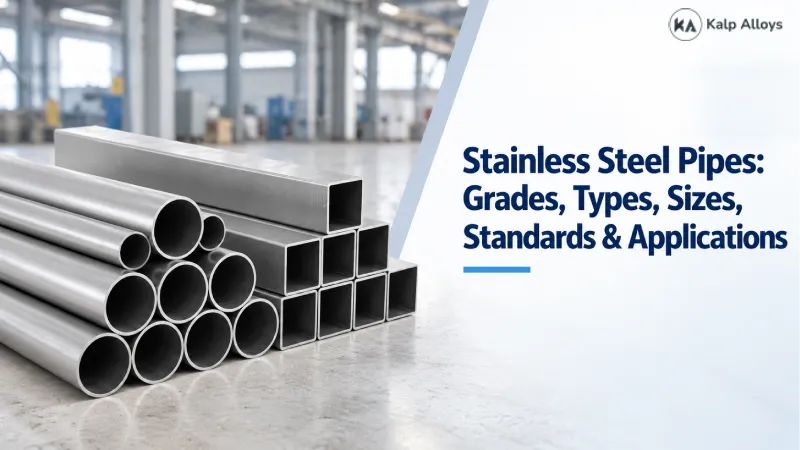
Industrial pipes are commonly identified through nominal pipe size (NPS) and wall-thickness schedule. Tubes are generally ordered using outside diameter, wall thickness and dimensional tolerances.
A pipe specification may focus on fluid transmission, while tubing can be required for heat exchangers, instrumentation or fabricated equipment.
As a Stainless Steel Tubes Manufacturer, we recommend checking the applicable product standard rather than assuming that pipes and tubes with similar dimensions are interchangeable.
Stainless Steel Pipe Grades: 304, 316, 321 and 347
Material selection should begin with an understanding of the process fluid and operating temperature. Different stainless steel compositions respond differently to corrosion, welding and heat exposure.
| Stainless Steel Grade | Material Characteristics | Common Application Areas |
|---|---|---|
| 304 / 304L | General corrosion resistance; 304L has lower carbon content | Industrial processing and fabricated piping |
| 316 / 316L | Molybdenum improves resistance to certain chloride-containing environments | Chemical processing and selected marine systems |
| 321 | Titanium-stabilised stainless steel | Certain elevated-temperature piping applications |
| 347 | Niobium-stabilised composition | High-temperature process systems |
| 310 / 310S | Higher chromium and nickel content | Selected high-temperature and oxidation-related applications |
SS 304 and SS 316 are commonly evaluated for industrial applications, but neither should be selected without reviewing service conditions.
As a Stainless Steel Pipes Exporter, we recommend confirming the exact grade designation, particularly when the project specifies low-carbon or stabilised stainless steel.
A higher-alloy grade is not automatically the correct material for every piping environment.
Seamless vs Welded Stainless Steel Pipes
The production method is another important purchasing consideration.
Seamless stainless steel pipes are manufactured without a longitudinal welded joint. They may be selected when the piping specification calls for seamless construction.
Welded stainless steel pipes are formed from flat material and joined along a longitudinal seam. They are used in many industrial systems when the relevant product standard permits welded construction.
Both methods can meet demanding requirements when the correct grade, specification and inspection criteria are applied.
A Stainless Steel Tubes Exporter should also distinguish between seamless tubing, welded tubing and products intended for specialised equipment applications.
Manufacturing method should follow the approved engineering specification rather than assumptions about product quality.
Stainless Steel Pipe Sizes, Schedules and Dimensions
A pipe's nominal size does not directly describe its measured outside diameter. This distinction matters when selecting compatible fittings, welding preparations and adjoining components.
Wall-thickness schedules provide another important dimensional reference. Stainless steel piping commonly uses schedule designations such as 5S, 10S, 40S and 80S under ASME B36.19M.
The selected wall thickness must satisfy the applicable design calculations, including pressure, temperature, corrosion allowance and manufacturing tolerances.
At Kalp Alloys, our stainless steel pipes and tubes offering includes different wall-thickness schedules and project-specific dimensional requirements.
For a clear enquiry, customers should provide the nominal pipe size or tube outside diameter, wall thickness, length and required tolerances.
ASTM Standards for Stainless Steel Pipes and Tubes
Not all stainless steel tubular products fall under the same ASTM specification. The correct standard depends on whether the order concerns process piping, general-service tubing or heat-transfer equipment.
- ASTM A312/A312M: Seamless, welded and heavily cold-worked austenitic stainless steel pipe.
- ASTM A269/A269M: Seamless and welded austenitic stainless steel tubing for general service.
- ASTM A213/A213M: Seamless tubes for boiler, superheater and heat-exchanger applications.
- ASTM A249/A249M: Welded austenitic steel tubes for boilers, heat exchangers and condensers.
As a Stainless Steel Pipes Manufacturer, we encourage customers to identify the applicable ASTM standard and material grade together.
ASTM standards define product requirements, while dimensional standards and engineering codes address other aspects of the completed piping system.
Industrial Applications of Stainless Steel Pipes
Stainless steel piping is considered across industries where the transported medium, hygiene requirements or surrounding environment influence material selection.
Typical applications include:
- Chemical processing: Transfer systems handling compatible process fluids.
- Food and pharmaceutical facilities: Processing lines requiring suitable materials and surface conditions.
- Oil and gas: Selected process and utility piping applications.
- Water treatment: Equipment and distribution systems exposed to different water chemistries.
- Power generation: Piping and tubing associated with thermal and auxiliary systems.
As a Stainless Steel Tubes Manufacturer, we recommend reviewing equipment-specific requirements, particularly for heat exchangers and applications involving controlled dimensional tolerances.
What Should Buyers Specify Before Ordering?
Incomplete material enquiries can lead to confusion between pipe and tube specifications, particularly when the intended use is not stated.
Before contacting a Stainless Steel Pipes Exporter or Stainless Steel Tubes Exporter, buyers should confirm:
- Stainless steel grade and applicable ASTM specification
- Seamless or welded construction
- Nominal pipe size or tube outside diameter
- Wall-thickness schedule or measured thickness
- Required length, tolerances and end preparation
- Operating pressure, temperature and process medium
- Material test certificates, inspection and quantity
These details help our team review the requirement and prepare a quotation based on the requested product specification.
Why Choose Us?
At Kalp Alloys, we support industrial buyers seeking stainless steel pipes and tubes for processing, fabrication and engineering applications. As a Stainless Steel Pipes Manufacturer and Stainless Steel Tubes Manufacturer, we focus on understanding the required material grade, manufacturing method, dimensions and inspection documentation. Our product offering includes EN 10204 3.1 material certification, with 3.2 certification and third-party inspection available on request. We work with domestic and international customers to clarify purchasing specifications before confirming supply requirements.
Conclusion
Selecting stainless steel pipes and tubes requires attention to material properties, manufacturing methods, dimensional requirements and applicable standards. SS 304, 316, 321 and 347 offer different characteristics, while ASTM A312, A269 and A213 apply to different tubular product requirements.
Understanding these distinctions helps buyers avoid material and dimensional mismatches during procurement.
As a Stainless Steel Pipes Exporter and Stainless Steel Tubes Exporter, we believe that clear technical specifications are the foundation of successful industrial purchasing.
At Kalp Alloys, our team supports customers in identifying suitable product options based on their submitted requirements.
Looking for stainless steel pipes or tubes for your next industrial project? Share your material grade, size, wall thickness, ASTM standard, quantity and delivery location with our sales team for a quotation. Call us: +91 81608 73937 & Email: sales@kalpalloys.com. Contact us today to discuss your stainless steel pipe and tube requirements.
Frequently Asked Questions
What are the different grades of stainless steel pipes?
The most common grades of stainless steel pipes include 304, 316, 321, and 347. Each grade has unique properties that make it suitable for specific applications, such as corrosion resistance, temperature stability, and mechanical performance.
What is the difference between seamless and welded stainless steel pipes?
Seamless stainless steel pipes are manufactured without any seams, making them suitable for high-pressure applications, while welded pipes are formed from flat material and joined along a seam. The choice between these two methods often depends on the specifications and requirements of the application.
How do I determine the size and schedule for stainless steel pipes?
When selecting stainless steel pipes, it's important to consider the nominal pipe size and wall-thickness schedule. The nominal size does not directly reflect the measured outside diameter, and various wall-thickness schedules (like 5S, 10S, or 40S) are used to specify dimension requirements.
What ASTM standards apply to stainless steel pipes and tubes?
Several ASTM standards govern stainless steel pipes and tubes, including ASTM A312 for seamless and welded pipes and ASTM A269 for general service tubing. It's essential to identify the relevant ASTM standard when ordering to ensure compliance with material and dimensional requirements.
What should I specify when contacting a stainless steel pipes manufacturer?
When reaching out to a stainless steel pipes manufacturer, you should provide details like the stainless steel grade, construction type (seamless or welded), nominal size, wall thickness, length, operating conditions, and inspection requirements. This clarity helps in receiving an accurate quotation and ensuring the right material for your application.