

Key Takeaways
- Understanding different types of stainless steel flanges is essential for optimal pipeline connections and maintenance.
- As a leading Stainless Steel Flanges Manufacturer, we emphasize the importance of selecting the appropriate material grade for specific applications.
- Key dimensions and standards must be considered to ensure compatibility and performance in stainless steel flange installations.
- Buyers should include detailed specifications in inquiries to prevent misunderstandings and ensure proper flange selection.
- Our range covers standard sizes from NPS ½ to NPS 24, accommodating various industrial requirements effectively.
Kalp Alloys is a leading manufacturer and exporter of stainless steel flanges for industrial piping applications.
A flange may appear compatible with a pipeline based on size alone, yet differences in its bore, bolt pattern or sealing surface can prevent proper installation. Material grade and temperature ratings introduce further considerations. As a Stainless Steel Flanges Manufacturer, we help industrial buyers identify these details before ordering components for new installations, equipment connections or maintenance projects.
What Are Stainless Steel Flanges?
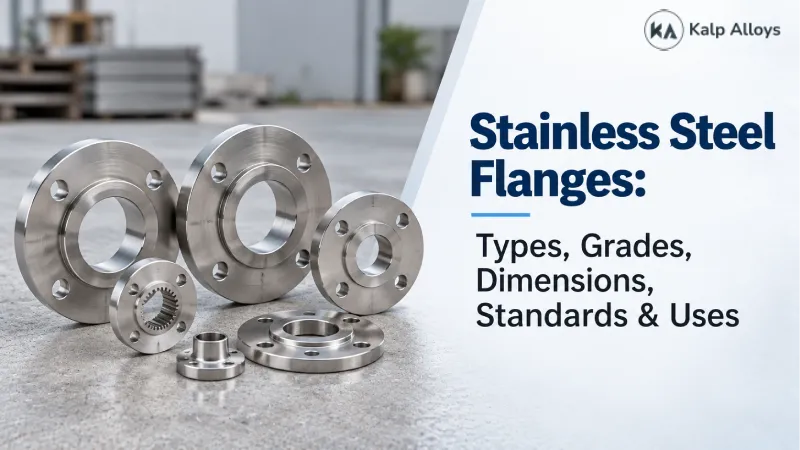
A stainless steel flange forms part of a bolted piping joint, allowing a pipe section or equipment connection to be separated when necessary.
Unlike a permanent welded joint between two pipe sections, a flanged connection provides access for maintenance or equipment replacement. The joint relies on the combined arrangement of the flanges, gasket and fasteners.
Stainless steel is used when the process environment requires suitable corrosion resistance. However, the material grade must be selected according to the fluid handled, operating temperature and service conditions.
Types of Stainless Steel Flanges and Their Uses
Flange designs differ primarily in how they connect to the pipe and how the joint is assembled.
Our range includes the following commonly specified configurations:
- Weld Neck Flanges: A tapered hub connects to the pipe through a butt weld. This design is frequently specified for demanding piping service.
- Slip-On Flanges: The pipe enters the flange bore before the connection is secured using fillet welds.
- Blind Flanges: These solid components close designated openings at pipeline ends or equipment connections.
- Socket Weld Flanges: Intended for compatible small-bore piping arrangements where the pipe enters a recessed socket.
- Threaded Flanges: Provide a mechanical connection to suitable threaded pipe without a welded attachment, where permitted by the design.
- Lap Joint Flanges: Used with a compatible stub end, allowing the backing flange to rotate during installation.
The choice between these configurations should follow the approved piping design rather than installation convenience alone.
Stainless Steel Flange Grades: 304 vs 316 vs 316L
Different stainless steel compositions respond differently to corrosive media and elevated temperatures. Buyers should therefore identify the specific grade required rather than ordering only by the general material category.
| Grade | Material Difference | Common Selection Consideration |
|---|---|---|
| SS 304 | General-purpose austenitic stainless steel | Industrial piping with compatible operating media |
| SS 304L | Lower-carbon variation of 304 | Fabricated and welded piping requirements |
| SS 316 | Contains molybdenum | Applications needing improved resistance to certain corrosive environments |
| SS 316L | Lower-carbon variation of 316 | Welded equipment and selected chemical-processing applications |
| SS 321 | Titanium-stabilised composition | Certain elevated-temperature service requirements |
| SS 347 | Niobium-stabilised composition | Selected high-temperature piping systems |
As a Stainless Steel Flanges Exporter, we support enquiries involving grades such as 304, 304L, 316, 316L, 321, 347 and other listed stainless steel materials.
SS 316L is not universally resistant to chloride corrosion. The effect of chloride concentration, temperature and crevice conditions still needs engineering evaluation.
Stainless Steel Flange Dimensions and Available Sizes
A nominal flange size does not provide all the information needed to confirm physical compatibility.
The dimensional drawing must account for the flange outside diameter, thickness, bolt-circle diameter, bolt-hole arrangement and central bore. Depending on the design, hub dimensions and gasket seating details are also relevant.
At Kalp Alloys, our stainless steel flange offering includes standard sizes from NPS ½ to NPS 24, with diameters up to NPS 48 available on request.
The product range includes ASME Class 150, 300, 600, 900, 1500 and 2500 designations, subject to standard-specific size and material restrictions.
Raised-face, flat-face and ring-type-joint configurations are available for applicable designs.
A flange's allowable pressure changes with temperature and material grade. Its nominal class must therefore be checked against the appropriate pressure-temperature rating rather than interpreted as a constant working pressure.
Which Standards Apply to Stainless Steel Flanges?
Buyers should distinguish between the specification controlling material composition and the standard defining flange geometry.
ASTM A182 / ASME SA182 addresses forged or rolled alloy and stainless steel components, including relevant flange materials.
ASME B16.5 covers pipe flanges and flanged fittings within its specified nominal size range, including dimensional and pressure-temperature requirements.
ASME B16.47 applies to large-diameter steel flanges from NPS 26 to NPS 60 and includes Series A and Series B designs.
EN 1092-1 specifies circular steel flanges using PN-based designations.
Selecting a standard also affects drilling arrangements, dimensions and mating compatibility. Flanges from different standard systems should not be assumed interchangeable.
Where Are Stainless Steel Flanges Used?
Industrial facilities specify stainless steel flanged connections for different operational reasons.
Chemical-processing equipment may require a grade compatible with the process fluid. Pharmaceutical and food-processing installations may introduce additional cleanliness and surface-finish requirements.
Water-treatment systems, power-generation facilities and selected marine installations also use stainless steel flanges where the applicable material properties meet the engineering specification.
As a Stainless Steel Flanges Manufacturer, we recommend evaluating the actual service conditions rather than assuming that one stainless steel grade suits every industry.
What Should Buyers Include in a Flange Enquiry?
The quality of an RFQ depends on whether the requested connection can be identified without assumptions.
Before sending requirements to a Stainless Steel Flanges Exporter, verify the following:
- Stainless steel grade and relevant material specification
- Flange configuration and nominal size
- Applicable ASME, EN or other dimensional standard
- Pressure class and gasket-facing arrangement
- Bore dimensions and connection-pipe wall thickness
- Design temperature and operating medium
- Quantity, material certification and inspection requirements
Additional drawings should be provided for non-standard dimensions or project-specific designs.
Why Choose Us?
At Kalp Alloys, we offer stainless steel flanges in multiple grades, connection types and dimensional specifications for industrial procurement requirements. As a Stainless Steel Flanges Manufacturer, we understand the importance of accurate material identification and compatible flange dimensions. Our offering includes EN 10204 3.1 material certification, with 3.2 certification and third-party inspection available on request. We work with buyers to clarify grade requirements, pressure classes, inspection expectations and export documentation before processing their enquiries.
Conclusion
Stainless steel flange selection requires more than identifying a nominal size and material family. The chosen product must correspond with the intended connection design, applicable dimensional standard and operating conditions.
Grades such as SS 304, SS 316 and SS 316L differ in corrosion-related properties, while ASTM A182, ASME B16.5 and ASME B16.47 address distinct material or dimensional requirements.
As a Stainless Steel Flanges Exporter, we encourage customers to provide complete technical details when requesting quotations. Clear specifications help prevent misunderstandings about flange type, dimensions, sealing arrangement and required documentation.
Need stainless steel flanges for your industrial piping project? Share your required grade, flange type, nominal size, pressure class, quantity and delivery destination with our sales team. Call us: +91 81608 73937 & Email: sales@kalpalloys.com. Contact our team today to request a quotation for your stainless steel flange requirements.
Frequently Asked Questions
What types of stainless steel flanges are available?
Stainless steel flanges come in various types, including weld neck, slip-on, blind, socket weld, threaded, and lap joint flanges. Each type serves specific applications and installation conditions, so it's important to choose the right design for your piping system.
How do I choose the right stainless steel flange grade?
Selecting the correct stainless steel flange grade depends on the fluid, operating temperature, and environmental conditions. Common grades include SS 304 for general use and SS 316 for corrosive environments, with SS 316L often preferred for welded applications.
What standards should I consider when purchasing stainless steel flanges?
When buying stainless steel flanges, reference standards such as ASTM A182 for material composition and ASME B16.5 for dimensional specifications. Familiarity with these standards ensures compatibility and proper performance in your piping applications.
Where are stainless steel flanges commonly used?
Stainless steel flanges are used in various industries, including chemical processing, pharmaceuticals, food production, water treatment, and power generation. Their corrosion resistance and mechanical properties make them suitable for demanding environments.
What information do I need to provide to a stainless steel flanges manufacturer?
When contacting a stainless steel flanges manufacturer, include specifications like the flange grade, configuration, nominal size, pressure class, and operating temperature. This ensures accurate quotations and appropriate product selection for your project.