

Key Takeaways
- Selecting duplex steel flanges for corrosive service requires consideration of material grade and environmental factors.
- Duplex Steel Flanges Manufacturer recommends evaluating chloride levels and operating conditions before material selection.
- Super duplex steel flanges are preferred in severe environments due to their higher resistance to localized corrosion.
- Understand pressure-temperature ratings to ensure the chosen flange meets safety and performance standards.
- Choose the appropriate flange type for high-pressure systems, with weld neck flanges often being the best option.
Kalp Alloys is a leading manufacturer and exporter of duplex and super duplex steel flanges for demanding industrial piping applications.
Selecting the wrong flange material for corrosive or high-pressure service can lead to premature deterioration, leakage and maintenance problems. As a Duplex Steel Flanges Manufacturer, we understand that choosing the correct grade involves more than checking pressure ratings. Chloride exposure, operating temperature, corrosion resistance and material specifications all influence flange performance.
What Makes Duplex Steel Flanges Ideal for High-Pressure and Corrosive Environments?
Duplex stainless steel combines austenitic and ferritic microstructures, offering high mechanical strength and improved resistance to chloride-induced stress corrosion cracking compared with conventional austenitic stainless steels.
These characteristics make duplex flanges a reliable choice for applications in chemical industries, offshore pipeline systems, desalination plants, and other environments exposed to chloride-rich conditions.
As a Duplex Steel Flanges Exporter, we recommend evaluating actual process conditions before selecting the material.
The main advantages include:
- High yield strength for demanding pressure applications
- Good resistance to chloride stress corrosion cracking
- Improved pitting and crevice corrosion resistance
- Suitability for selected marine and chemical environments
- Strong mechanical performance under appropriate service conditions
Duplex steel offers an effective combination of strength and corrosion resistance, but its suitability depends on the operating environment.
Duplex vs Super Duplex Steel Flanges: Which Grade Should You Choose?
Duplex and super duplex stainless steels differ in their chemical compositions and their ability to withstand various forms of corrosion.
As a Super Duplex Steel Flanges Manufacturer, we supply grades including ASTM A182 F53 and F55 for applications requiring enhanced resistance to aggressive chloride environments.
| Selection Factor | Duplex Steel Flanges | Super Duplex Steel Flanges |
|---|---|---|
| Common grades | ASTM A182 F51, F60 | ASTM A182 F53, F55 |
| UNS designations | S31803, S32205 | S32750, S32760 |
| Chromium content | Approximately 21–23% | Approximately 24–26% |
| Corrosion resistance | Good chloride resistance | Higher resistance to chloride pitting |
| Typical applications | Process piping, chemical plants | Seawater, offshore, desalination |
The main difference is the level of corrosion resistance required, not simply the operating pressure.
Super duplex stainless steel is typically preferred when conventional duplex grades cannot offer adequate protection against localized corrosion.
How to Select Duplex Steel Flanges for High-Pressure Applications
Flange selection should follow a clear engineering process. When selecting a flange manufacturer, we suggest considering the following key factors before making a purchase.
- Identify the operating environment: Determine chloride concentration, process chemicals, temperature and potential corrosive conditions.
- Select the most suitable material grade: ASTM A182 F51 or F60 may be considered for standard duplex stainless steel applications, while F53 or F55 are better suited to highly corrosive and demanding operating environments.
- Check pressure-temperature ratings: Confirm the selected flange class against the applicable ASME standard at the design temperature.
- Select the flange type: Weld neck flanges are commonly preferred for demanding high-pressure and cyclic service, subject to piping design requirements.
- Verify dimensional compatibility: Check nominal size, pipe schedule, bore, facing and bolt-hole dimensions.
- Specify inspection requirements: Define material certification, traceability and any supplementary corrosion or mechanical testing.
A higher pressure class alone does not make a flange suitable for every corrosive application.
Which Flange Types Are Suitable for Corrosive Service?
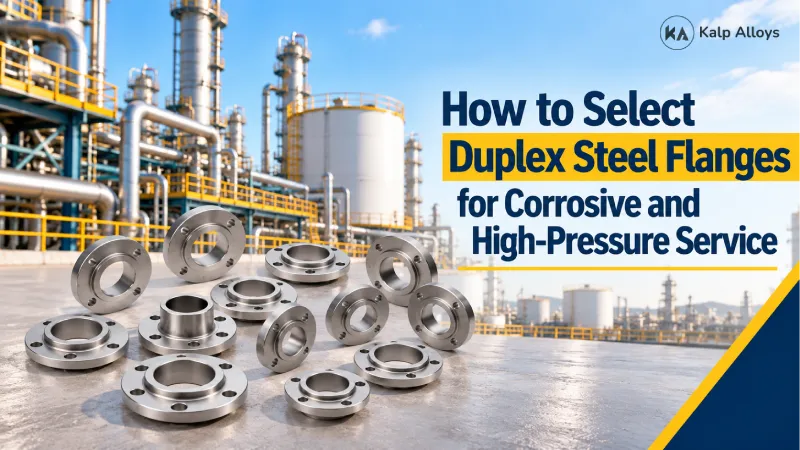
Different flange designs serve different purposes. At Kalp Alloys, our duplex and super duplex range includes weld neck, slip-on, blind, socket weld, threaded and lap joint configurations.
Weld neck flanges are often selected for demanding pressure systems because their tapered hub provides a gradual transition between pipe and flange. Blind flanges are used to close piping openings, while socket weld designs may be specified for suitable small-bore applications.
As a Super Duplex Steel Flanges Exporter, we recommend selecting the flange configuration according to the piping design code, joint requirements and intended service.
Important Standards, Pressure Classes and Testing
Material grade and dimensional standards must be specified separately.
Our duplex and super duplex flange range includes ASTM A182 material grades and dimensional standards such as ASME B16.5, ASME B16.47 and EN 1092-1.
The available pressure ratings range from Class 150 to Class 2500, covering Classes 150, 300, 600, 900, 1500, and 2500. These are offered with three flange-facing configurations: raised face (RF), flat face (FF), and ring-type joint (RTJ).
As a Duplex Steel Flanges Exporter, we support projects requiring material documentation and defined inspection procedures.
Before ordering, buyers should verify:
- Correct ASTM A182 grade and UNS designation
- Applicable dimensional standard and pressure class
- Flange facing and pipe compatibility
- EN 10204 3.1 or requested 3.2 certification
- Heat-number traceability
- Required corrosion, ferrite or non-destructive testing
Additional requirements such as ASTM A923, ASTM G48 or NACE MR0175 / ISO 15156 should be specified where applicable.
When Is Super Duplex Stainless Steel a Better Choice Than Duplex Stainless Steel?
Standard duplex is not automatically suitable for every seawater or chloride-containing system.
Where chloride concentration, temperature and localised corrosion risks are more severe, super duplex grades such as UNS S32750 and S32760 may offer a more appropriate material solution.
As a Super Duplex Steel Flanges Manufacturer, we recommend reviewing pitting resistance, crevice conditions and project-specific corrosion requirements before finalising the grade.
The selection of suitable materials must also account for manufacturing methods, welding requirements, and the temperature limits associated with their intended operating conditions.
Why Choose Us
At Kalp Alloys, we manufacture and supply duplex and super duplex steel flanges for industrial piping requirements. Our range includes ASTM A182 F51, F60, F53 and F55 grades, with multiple flange types, pressure classes and facing options. As a Super Duplex Steel Flanges Exporter, we support domestic and international B2B buyers with defined material specifications, heat-number traceability, material test certificates and inspection options. Our team works with customer drawings and technical requirements to identify suitable flange configurations for quotation.
We support B2B buyers who need more than a generic flange description, with a full range of material grades and options to match your project's unique operating conditions.
Conclusion
Choosing duplex steel flanges for corrosive and high-pressure service requires careful evaluation of material grade, corrosion conditions, pressure-temperature ratings and flange design. ASTM A182 F51 and F60 are commonly considered for suitable duplex applications, while super duplex grades F53 and F55 offer enhanced resistance in more aggressive chloride environments.
Neither material should be selected on strength alone. Correct dimensions, compatible piping components, appropriate testing and project documentation are equally important.
We help industrial buyers translate these requirements into clear flange specifications, supporting informed material selection and smoother procurement for demanding piping projects.
Looking for duplex or super duplex steel flanges for your industrial project? Contact our team for a quotation on ASTM A182 F51, F60, F53 and F55 flanges. Share your required grade, size, pressure class, flange type, quantity and delivery location. Call us: +91 81608 73937
Email: sales@kalpalloys.com
Send us your flange requirements today and get a quotation tailored to your project specifications.
Frequently Asked Questions
What factors should I consider when selecting duplex steel flanges for corrosive environments?
When selecting duplex steel flanges, consider the chloride concentration, operating temperature, process chemicals, and potential corrosive conditions. The material grade, whether ASTM A182 F51, F60, F53, or F55, should match the specific service requirements to ensure optimal performance.
Why is super duplex steel better for high-pressure applications than standard duplex steel?
Super duplex steel offers enhanced resistance to localised corrosion compared to standard duplex materials. In environments with high chloride concentrations and severe corrosion risks, super duplex grades like UNS S32750 and S32760 are preferable for ensuring long-term reliability.
What types of flanges are available for corrosive and high-pressure service?
In our range, we offer various flange types including weld neck, slip-on, blind, socket weld, threaded, and lap joint configurations. The choice of flange type should be based on piping design codes, joint requirements, and the specific service conditions.
How do I ensure I'm choosing the right duplex steel flanges manufacturer?
Select a manufacturer like Kalp Alloys that provides comprehensive material certifications, traceability, and testing options. It's important to verify their experience in supplying duplex steel flanges suitable for your specific high-pressure and corrosive application needs.
What are the main advantages of using duplex steel flanges in industrial applications?
Duplex steel flanges provide a high yield strength for pressure applications, good resistance to chloride stress corrosion cracking, and improved pitting and crevice corrosion resistance. These features make them suitable for demanding environments such as chemical plants and offshore applications.