

Key Takeaways
- Understanding carbon steel pipes' grades is crucial for ensuring compatibility with industrial applications.
- Always confirm the material grade and applicable specifications before purchasing carbon steel pipes or tubes.
- Seamless carbon steel pipes are ideal for high-temperature applications, while ERW pipes suit general industrial use.
- Selecting the right nominal size and wall thickness is essential to prevent system failures in piping.
- Kalp Alloys serves as a trusted Carbon Steel Pipes Manufacturer, supporting tailored solutions for industrial piping needs.
Kalp Alloys is a leading manufacturer and exporter of carbon steel pipes and tubes for industrial piping applications.
Choosing the wrong pipe grade, size or wall thickness can affect an entire piping system. From oil and gas transportation to power plants and industrial processing, carbon steel pipes are widely specified for their strength, weldability and versatility. As a Carbon Steel Pipes Manufacturer and Carbon Steel Pipes Exporter, we help industrial buyers identify suitable pipes based on their material standards, dimensions and service requirements.
What Are Carbon Steel Pipes and Tubes?
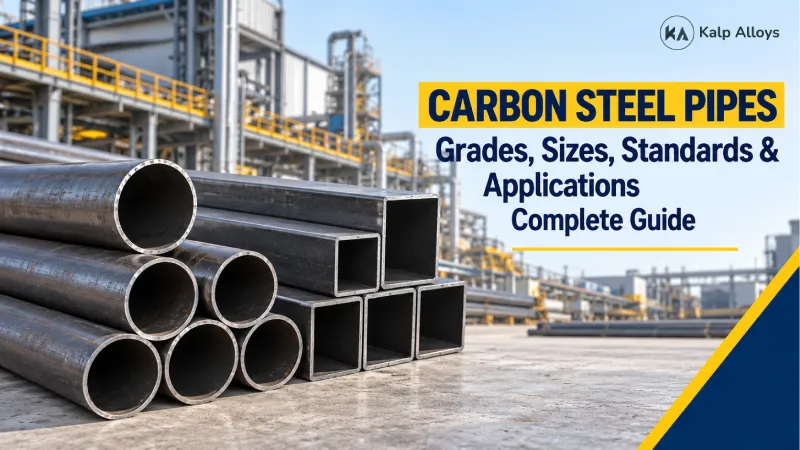
Carbon steel pipes are hollow cylindrical products manufactured primarily from iron and carbon, with other elements controlled according to the applicable material specification. They are used to transport liquids, gases and steam in industrial piping systems.
Carbon steel tubes may serve mechanical, structural, heat-transfer or instrumentation applications, depending on their specifications and manufacturing processes.
As a Carbon Steel Tubes Manufacturer, we understand that pipes and tubes are not always interchangeable. Pipes are generally specified using nominal pipe size (NPS) and schedule, while tubes are commonly ordered by outside diameter and wall thickness.
Common Grades of Carbon Steel Pipes
Selecting the appropriate material grade is essential because different ASTM and API specifications address different operating requirements.
| Material Grade | Key Characteristics | Typical Applications |
|---|---|---|
| ASTM A106 Gr B | Seamless carbon steel pipe for high-temperature service | Refineries, steam and process piping |
| ASTM A53 Gr A/B | Seamless and welded steel pipe specification | General industrial and utility piping |
| ASTM A333 Gr 6 | Carbon steel pipe with low-temperature requirements | Low-temperature industrial piping |
| API 5L Gr B | Line pipe specification for pipeline transportation | Oil and gas pipelines |
| API 5L X42–X70 | Higher-strength line pipe grades | Energy transmission pipelines |
ASTM A106 Grade B and ASTM A53 Grade B are commonly requested grades, but the final selection should depend on the operating temperature, pressure, fluid and governing design code.
As a Carbon Steel Pipes Exporter, we recommend confirming the exact material grade before ordering rather than treating all carbon steel specifications as equivalent.
Carbon Steel Pipe Sizes, Dimensions and Schedules
Carbon steel pipes are produced in a wide range of nominal diameters and wall thicknesses to meet the specific demands of various industrial applications.
Pipe size and schedule are two separate specifications. The nominal pipe size identifies the general pipe dimension, while the schedule helps identify the corresponding wall thickness under applicable dimensional standards.
Common schedule designations include:
- SCH 10: Relatively thin-wall piping configurations.
- SCH 20: An alternative pipe wall-thickness specification available for selected pipe dimensions.
- SCH 40: Commonly specified for general industrial piping.
- SCH 80: A thicker-wall pipe specification designed to withstand more demanding operating conditions.
- SCH 160: Heavy-wall configurations for selected pipe sizes.
- XXS: Extra-extra-strong wall designation.
Not every schedule is available for every nominal size. The actual outer diameter, wall thickness, and weight must be verified in accordance with the relevant ASME dimensional specifications.
As a Carbon Steel Tubes Exporter, we also work with requirements defined by tube outside diameter, wall thickness, length and applicable material specification.
Seamless vs ERW Carbon Steel Pipes
Manufacturing methods affect pipe construction, available dimensions and suitability for particular applications.
| Feature | Seamless Pipes | ERW Pipes |
|---|---|---|
| Manufacturing | Formed without a longitudinal weld seam | Produced using electric resistance welding |
| Weld Seam | No longitudinal weld seam | Longitudinal welded seam |
| Specifications | Commonly ASTM A106 and applicable seamless grades | Commonly ASTM A53 and applicable welded grades |
| Applications | Process and pressure piping | Utility, structural and pipeline applications |
| Selection | Based on design conditions and pipe specification | Based on design conditions and weld requirements |
Seamless pipes are not automatically necessary for every high-pressure application. Both seamless and welded products must satisfy the relevant material specification and design requirements.
Our experience as a Carbon Steel Pipes Manufacturer helps buyers identify suitable product specifications before procurement.
Important Standards for Carbon Steel Pipes and Tubes
International standards define material properties, manufacturing requirements, dimensions and testing criteria.
The major ASTM specifications include ASTM A106, which addresses seamless carbon steel pipes intended for high-temperature service; ASTM A53, which establishes requirements for seamless and welded steel pipes; and ASTM A333, which specifies seamless and which specifies piping materials suitable for low-
API 5L covers line pipe for pipeline transportation systems. ASME B36.10M provides dimensional information for welded and seamless wrought steel pipes.
The appropriate standard for carbon steel tubing is determined by its intended use and specific application requirements.ASTM A179, for example, covers seamless cold-drawn low-carbon steel tubes for specified heat-exchanger and condenser applications.
As a Carbon Steel Tubes Manufacturer, we recommend verifying the relevant ASTM or ASME requirement before finalising an order.
Industrial Applications of Carbon Steel Pipes
Carbon steel pipes and tubes serve several industrial sectors because different grades and manufacturing types can support different operating conditions.
Common applications include:
- Oil and Gas: Pipeline transportation and processing systems.
- Power Generation: Steam lines and plant utility piping.
- Petrochemical: Process piping and refinery installations.
- Chemical Processing: Compatible industrial fluid-handling systems.
- Construction: Structural and mechanical applications.
- Heat Exchangers: Tube applications requiring suitable material and dimensional specifications.
As a Carbon Steel Tubes Exporter, we understand the importance of matching tube specifications with operating conditions, fabrication needs and equipment requirements.
How to Choose the Right Carbon Steel Pipes and Tubes
Before purchasing, industrial buyers should check the following requirements:
- Material grade and applicable ASTM/API specification
- Seamless, ERW or other manufacturing method
- Nominal pipe diameter or external tube diameter.
- Wall thickness and pipe schedule
- Operating temperature and design pressure
- Required length, end finish and quantity
- Material test certificates and inspection requirements
A detailed technical enquiry helps reduce material mismatches and unnecessary procurement delays.
Why Choose Us?
At Kalp Alloys, we focus on supplying carbon steel pipes and tubes according to clearly defined industrial requirements. Our range covers seamless and welded configurations, multiple schedule options and applicable ASTM/ASME specifications. As a Carbon Steel Pipes Exporter and Carbon Steel Tubes Manufacturer, we support buyers with grade selection, dimensional requirements and material documentation. We offer EN 10204 3.1 material test certificates, with 3.2 certification and third-party inspection available on request, helping customers address their project procurement requirements.
Conclusion
Carbon steel pipes and tubes remain important components in industrial piping, mechanical systems and energy infrastructure. However, choosing the correct material involves more than selecting a nominal size or standard grade. ASTM A106, ASTM A53, ASTM A333 and API 5L serve different requirements, while pipe schedules and manufacturing methods influence the final specification. As a Carbon Steel Pipes Manufacturer and Carbon Steel Tubes Exporter, we believe buyers benefit from evaluating material grades, wall thicknesses, service conditions and testing requirements together. Kalp Alloys supports industrial procurement with carbon steel piping solutions based on detailed project specifications.
Looking for carbon steel pipes and tubes for your next industrial project? Contact Kalp Alloys today to discuss your required grade, pipe or tube size, schedule, quantity and documentation. Our team is ready to review your enquiry and provide a quotation. Call us: +91 81608 73937
Email: sales@kalpalloys.com
Send your RFQ today for carbon steel pipes and tubes manufactured to your project requirements.
Frequently Asked Questions
What are the common grades of carbon steel pipes?
Common grades of carbon steel pipes include ASTM A106 Gr B, ASTM A53 Gr A/B, ASTM A333 Gr 6, and API 5L Gr B. Each grade serves different operating conditions, making it crucial to select one that matches the specific requirements of your application.
How do I choose the right carbon steel pipes for my project?
To select the right carbon steel pipes, consider factors such as material grade, manufacturing method (seamless or ERW), pipe size, wall thickness, and the operating conditions of temperature and pressure. A detailed technical enquiry will help minimize mismatches and procurement delays.
What is the difference between seamless and ERW carbon steel pipes?
Seamless carbon steel pipes are formed without a weld seam, making them suitable for high-pressure applications, while ERW (Electric Resistance Welded) pipes have a longitudinal weld seam. Each type is designed for specific applications based on the required strength and manufacturing specifications.
Which industries commonly use carbon steel pipes?
Industries such as oil and gas, power generation, petrochemical, and chemical processing commonly use carbon steel pipes. Their strength and versatility make them ideal for applications in structural, mechanical, and fluid handling systems.
What should I verify before purchasing from a carbon steel pipes manufacturer?
Before purchasing from a carbon steel pipes manufacturer, verify the material grade, applicable specifications, manufacturing method, nominal pipe diameter, wall thickness, and any required material test certificates. This ensures compliance with your project's specific needs and reduces the risk of error.