

Key Takeaways
- Understanding compatibility factors is crucial for effective use of carbon steel flanges in oil and gas applications.
- Carbon steel flanges manufacturers must evaluate service conditions to ensure proper material selection for specific environments.
- Selecting carbon steel flanges involves considering pressure, temperature, fluid chemistry, and corrosion risks for optimal performance.
- Not every application is suited for carbon steel; evaluate corrosive conditions and temperature limits before selection.
- Collaborating with a reliable carbon steel flanges exporter ensures adherence to project specifications and material requirements.
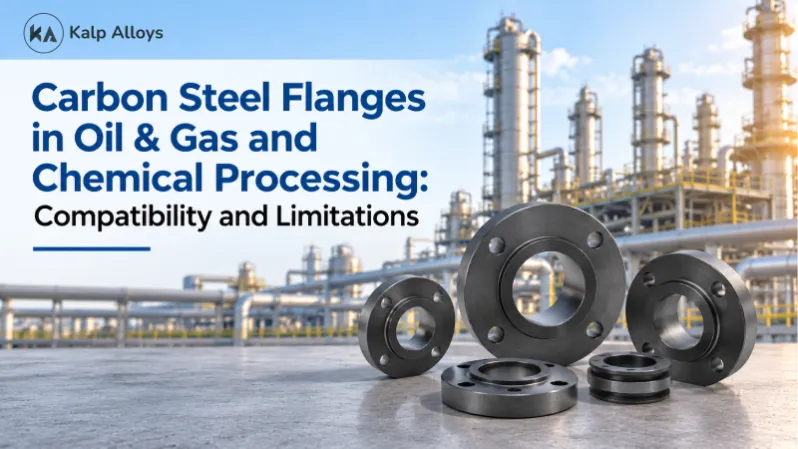
Kalp Alloys is a leading manufacturer and exporter of carbon steel flanges. In oil and gas and chemical processing facilities, flange selection is closely linked to pressure, temperature, fluid chemistry, and piping design. A qualified Carbon Steel Flanges Manufacturer must therefore consider service conditions rather than treating carbon steel as a universal material for every application.
Carbon steel flanges are widely used for industrial piping connections, but their compatibility has practical limits. Understanding where they perform well and where another alloy may be more suitable helps engineers and buyers make better material decisions.
Why Are Carbon Steel Flanges Used in Oil & Gas?
Carbon steel is commonly selected for piping systems because it combines useful mechanical properties with established fabrication and joining practices. Flanges provide detachable connections between pipes, valves, pumps, vessels, and other equipment.
In oil and gas facilities, carbon steel flanges may be considered for services involving hydrocarbons, water, gases, and other process streams when the selected grade and pressure-temperature rating are appropriate for the application.
Material selection should always be based on the actual process conditions, not simply on the name of the fluid.
For example, a hydrocarbon service can have very different requirements depending on operating temperature, pressure, water content, contaminants, and corrosion conditions.
Compatibility With Oil and Gas Service
Carbon steel can be suitable for many oil and gas piping applications, particularly where the process environment does not impose corrosion conditions beyond the material's capabilities.
The compatibility assessment should consider:
- Operating and design pressure
- Operating and design temperature
- Fluid composition
- Water and moisture exposure
- Potentially corrosive contaminants
- Internal and external corrosion conditions
- Applicable piping and flange specifications
A carbon steel flange may perform well in one hydrocarbon service and require additional corrosion protection or a different material in another. This is why specifications must be reviewed alongside the piping system's operating conditions.
Carbon Steel Flanges in Chemical Processing
Chemical processing environments can be more demanding because different chemicals can interact with metallic materials in different ways. Carbon steel is not inherently resistant to every chemical environment.
Its suitability depends on the concentration, temperature, pressure, contaminants, and exposure conditions associated with the chemical service.
For certain process chemicals, especially corrosive media, carbon steel may require corrosion control measures or may not be the preferred material at all. In such situations, stainless steel, alloy steel, nickel alloys, or other specialized materials may provide better resistance, depending on the service.
Chemical compatibility must be evaluated for the exact process medium and operating conditions.
Key Compatibility Factors
When selecting carbon steel flanges for oil and gas or chemical service, several technical factors should be reviewed together rather than individually.
Pressure and Temperature
Flange pressure ratings are linked to material grade, flange specification, and temperature. As temperature increases, allowable pressure can change according to the applicable standard and material requirements.
The flange should therefore be selected using the required pressure-temperature rating rather than nominal pipe size alone.
Fluid Chemistry
The chemical composition of the process fluid has a direct effect on corrosion risk. Water, dissolved gases, acidic components, salts, and other contaminants can influence the suitability of carbon steel.
In chemical processing, the exact chemical concentration and operating temperature are particularly important.
Corrosion Conditions
Carbon steel can be vulnerable to corrosion under conditions where moisture and aggressive chemical species are present. Internal corrosion may affect the wetted surface, while external corrosion can occur where the flange is exposed to atmospheric moisture, process leakage, condensation, or other environmental factors.
A Carbon Steel Flanges Manufacturer should therefore manufacture flanges to the specified material and dimensional requirements while the engineering team evaluates whether carbon steel is appropriate for the service.
Where Are Carbon Steel Flanges Less Suitable?
Carbon steel has limitations that should be recognized before it is specified for demanding applications.
In general, greater attention is required where the service involves:
- Highly corrosive chemicals
- Aggressive aqueous environments
- Elevated temperatures beyond the material's applicable limits
- Severe erosion-corrosion conditions
- Services requiring unusually high corrosion resistance
- Process conditions where material degradation could compromise equipment integrity
In these cases, a different material or protective strategy may be considered based on engineering assessment.
It is also important not to assume that coating alone makes an unsuitable material compatible with a highly aggressive process fluid. Internal wetted surfaces, flange faces, gaskets, bolting, and connected piping all need to be considered as part of the complete system.
Carbon Steel vs More Corrosion-Resistant Materials
The choice between carbon steel and a higher-alloy material depends on the service requirements. The following comparison provides a practical overview.
| Factor | Carbon Steel | Stainless or Higher-Alloy Material |
|---|---|---|
| General industrial piping | Frequently suitable | Suitable |
| Mild service environments | Often suitable | Suitable |
| Corrosive chemical service | May require careful evaluation | Often considered where greater resistance is needed |
| Moisture-related corrosion | Requires corrosion management | Resistance varies by alloy |
| High-temperature service | Depends on grade and rating | Depends on alloy and application |
| Material selection priority | Mechanical performance and service compatibility | Corrosion resistance plus mechanical performance |
This comparison is only a starting point. The correct material depends on the exact grade, process conditions, applicable standards, and engineering requirements.
What Should Buyers Check Before Ordering?
For industrial projects, flange selection should be verified against the project specification and piping requirements before procurement. A buyer working with a Carbon Steel Flanges Exporter can use the following checklist during technical review:
- Material grade and material specification
- Nominal size and flange dimensions
- Pressure class or required rating
- Facing type
- Applicable manufacturing standard
- Temperature and service conditions
- Required inspection and testing documentation
- Traceability requirements, where specified
- Compatibility with the mating flange and gasket arrangement
These checks can reduce the risk of selecting a flange that meets dimensional requirements but does not match the actual service conditions.
Why Flange Standards Matter
Flanges are manufactured according to recognized dimensional and material standards. The selected standard determines important details such as dimensions, pressure ratings, facing arrangements, and material requirements.
The flange should match the project's designated piping standard and equipment connection requirements. Mixing components without checking dimensions, ratings, facing, and material compatibility can create installation and performance problems.
Correct dimensional compatibility is just as important as selecting the right base material.
Choosing a Reliable Supplier
Industrial buyers should look beyond product availability when selecting a flange supplier. A reliable supplier should be able to provide clear product specifications and manufacture or supply the required flange according to the agreed technical requirements.
For projects involving oil and gas or chemical processing, documentation, traceability, dimensional accuracy, and consistency across the supplied batch can also be important procurement considerations.
At Kalp Alloys, we focus on supplying carbon steel flanges according to customer requirements and applicable technical specifications. Our team understands that industrial flange procurement involves more than selecting a nominal size; the flange must correspond to the intended piping application.
Why Choose Us
At Kalp Alloys, we focus on supplying carbon steel flanges for industrial applications with attention to specified dimensions, material requirements, and customer requirements. Our approach is based on understanding the technical details provided for the application and supplying products accordingly. We work with buyers who require dependable industrial piping components for demanding sectors such as oil and gas and chemical processing, while keeping product specifications and application requirements at the center of our process.
Conclusion
Carbon steel flanges can be an effective choice for many oil and gas and industrial piping applications when the material, pressure rating, temperature range, and service environment are compatible. However, carbon steel is not suitable for every chemical or corrosive service. Fluid chemistry, corrosion conditions, temperature, pressure, and applicable standards must all be reviewed before selection.
For engineering and procurement teams, working with an experienced Carbon Steel Flanges Exporter can simplify specification review and product sourcing. The most suitable flange is not simply the one that fits the pipe; it is the one that meets the complete requirements of the process and piping system.
Looking for carbon steel flanges for your oil & gas, chemical processing, or industrial piping project? Kalp Alloys can assist with product specifications and your flange requirements.
Call us: +91 81608 73937
Email: sales@kalpalloys.com
Frequently Asked Questions
What factors should I consider when choosing carbon steel flanges for oil & gas applications?
When selecting carbon steel flanges for oil & gas, it’s crucial to evaluate pressure ratings, temperature ranges, fluid chemistry, and potential corrosive conditions. Each of these factors plays a significant role in determining the flange’s suitability for specific applications.
Are carbon steel flanges suitable for chemical processing?
Carbon steel flanges can be used in chemical processing, but their compatibility largely depends on the specific chemicals involved, their concentration, and the operational conditions. In more corrosive environments, alternative materials like stainless steel may be more appropriate.
How can I verify the quality when sourcing from a carbon steel flanges manufacturer?
It's essential to check the manufacturer’s adherence to recognized standards, material specifications, and dimensional requirements. Additionally, ensure they offer proper documentation, traceability, and testing to meet your project needs.
What limitations do carbon steel flanges have in harsh environments?
Carbon steel flanges may not perform well in solutions with highly corrosive chemicals, severe erosion, or extreme temperatures. In such scenarios, it's advisable to opt for higher-alloy materials that offer better resistance to these challenging conditions.
What should I check before ordering carbon steel flanges from an exporter?
Before placing an order, confirm material grades, flange dimensions, pressure classes, and facing types. Also, review the temperature compatibility and any testing documentation required to ensure the flanges meet the specified service conditions.