

Key Takeaways
- ASTM A105 carbon steel flanges are suitable for general pressure applications at ambient and elevated temperatures.
- Choosing the right flange grade requires consideration of specific service conditions and environmental factors.
- As a leading Carbon Steel Flanges Manufacturer, we emphasize clear specifications to align with project requirements.
- For projects with low-temperature needs, consider ASTM A350 LF2 as an appropriate alternative to A105.
- Understanding the distinctions between A105 and other grades like A694 is crucial for high-strength applications.
Kalp Alloys is a leading manufacturer of carbon steel flanges for industrial piping applications.
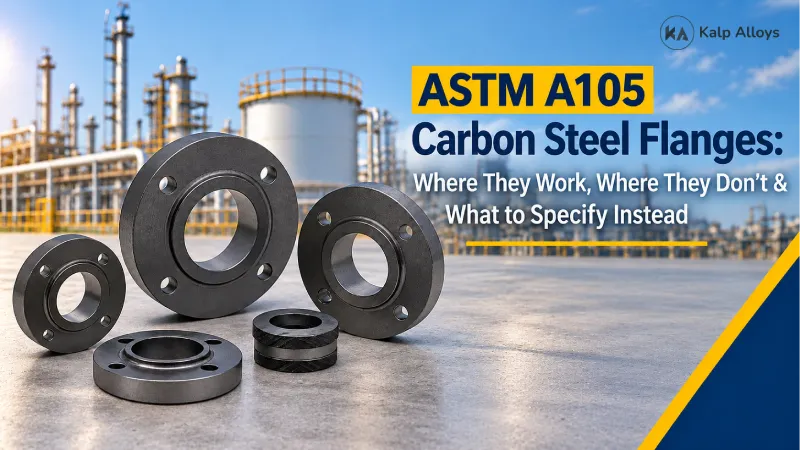
ASTM A105 is one of the commonly specified carbon steel forging grades for pressure-system components, but selecting A105 simply because a project requires carbon steel can create specification problems. As a Carbon Steel Flanges Manufacturer, we believe buyers should consider service temperature, pressure, piping standard, environment and mechanical requirements before finalising the material grade. ASTM A105 specifies forged carbon steel piping components designed for pressure applications at ambient and elevated temperatures.
Where ASTM A105 Carbon Steel Flanges Work
ASTM A105 specifies forged carbon steel parts, including flanges, fittings, valves and other components used in pressurized systems. This makes it relevant to a broad range of general industrial piping applications where the specified operating conditions and design code permit carbon steel.
As a Carbon Steel Flanges Exporter, we commonly work with flange requirements where buyers must define not only ASTM A105 but also the dimensional standard, pressure class, flange type and facing.
Typical A105 flange configurations can include:
- Weld neck flanges
- Slip-on flanges
- Blind flanges
- Socket weld flanges
- Threaded flanges
- Lap joint flanges
A105 specifies the material standard but does not cover all flange requirements. The dimensional standard and design conditions still need to be stated.
ASTM A105 vs Other Carbon Steel Flange Grades
Different operating conditions can require a grade other than A105. A useful comparison is:
| Grade | General Specification Intent | When Buyers Commonly Consider It |
|---|---|---|
| ASTM A105 / A105N | Carbon steel forgings for ambient and higher-temperature pressure service | General pressure piping |
| ASTM A350 LF2 | Carbon and low-alloy steel forgings requiring notch-toughness testing | Low-temperature service |
| ASTM A350 LF3 | Low-temperature forging specification | Specific low-temperature applications |
| ASTM A694 F42–F70 | High-strength carbon/alloy steel forgings | High-pressure transmission and pipeline requirements |
| ASTM A182 Grades | Alloy and stainless-steel forged piping components | Applications requiring alloy/stainless material properties |
The correct selection depends on the governing design code and actual service conditions rather than grade popularity alone.
Where ASTM A105 May Not Be the Right Choice
Working with an experienced Carbon Steel Flanges Manufacturer becomes important when operating conditions move beyond general carbon steel service.
Low-temperature applications are a key example. Where project specifications require defined notch toughness at low temperature, ASTM A350 grades such as LF2 may be considered instead of automatically specifying A105.
Highly corrosive processing conditions also need careful assessment. Standard carbon steel may not provide the corrosion resistance needed for every chemical or marine-related process. Depending on the medium, temperature, and corrosion resistance requirements, stainless steel or another suitable corrosion-resistant alloy may be needed.
Higher-strength pipeline projects can present another limitation. If the design specifically calls for higher-yield-strength forged components, ASTM A694 grades may be more appropriate than A105.
What Should You Specify Instead?
ASTM A105 does not have a single direct substitute. The alternative should match the reason A105 is unsuitable.
- For low-temperature requirements: Review ASTM A350 LF2 or another grade specified by the project design.
- For high-strength pipeline applications: Use suitable ASTM A694 grades as specified by engineering requirements.
- For corrosive environments: Evaluate an appropriate stainless steel or corrosion-resistant alloy according to process media and project requirements.
- For alloy-steel service: Select the applicable ASTM A182 alloy grade based on temperature, pressure and design-code requirements.
Our role as a Carbon Steel Flanges Exporter is not simply to supply a flange marked with a requested grade. Clear purchasing specifications help align material, dimensions, testing and documentation with the actual project requirement.
What B2B Buyers Should Include in an A105 Flange Enquiry
Before sending an RFQ, buyers can use this checklist to reduce specification ambiguity:
- ASTM material specifications, including A105 and A105N.
- Flange type, such as weld neck, slip-on or blind
- Nominal pipe size and required quantity
- Pressure class or PN rating
- Applicable dimensional standard
- Facing requirement, such as RF, FF or RTJ
- Certification, inspection or additional testing requirements
A complete RFQ is particularly important because pressure class and material grade are separate engineering considerations. Pressure-temperature suitability should always be checked against the applicable design standard.
Kalp Alloys supplies carbon steel flange configurations covering standards including ASME B16.5 and ASME B16.47, with pressure classes listed from Class 150 through Class 2500. Our carbon steel grades include ASTM A105/A105N, ASTM A350 LF2/LF3, and ASTM A694 F42 to F70.
Material Documentation and Inspection Requirements
Documentation requirements should be finalized when preparing the purchase order rather than addressed later. As a Carbon Steel Flanges Manufacturer, we advise confirming certification, inspection and traceability requirements during the enquiry stage.
Kalp Alloys lists EN 10204 3.1 certification as part of its carbon steel flange offering, with 3.2 certification available on request. The listed inspection capabilities include ultrasonic, magnetic particle, dye penetrant, dimensional and other applicable examinations, with third-party inspection available when specified.
Why Choose Us
At Kalp Alloys, we support B2B buyers who need more than a generic flange description. Our carbon steel flange range includes A105/A105N, A350 LF2/LF3 and A694 F42–F70 grades, along with multiple flange types, pressure classes and facing options. As a Carbon Steel Flanges Exporter, we handle project enquiries where material traceability, dimensions, documentation and inspection requirements must be clearly specified before supply.
Conclusion
ASTM A105 is widely recognized as a material standard for forged carbon steel flanges intended for pressure-containing applications at ambient and elevated temperatures. However, its suitability should be assessed against specific operating conditions. Low-temperature toughness requirements, higher-strength pipeline service, corrosive media or alloy-specific operating conditions may point toward A350, A694, ASTM A182 or another engineering-approved material. The best flange specification starts with service conditions and the governing design standard, not simply the material name. Our team can review your stated grade, size, class, facing, standard and documentation requirements before quotation.
Planning a carbon steel flange requirement for an industrial piping or project application? Send your grade, flange type, size, pressure class, quantity and inspection requirements to our sales team for a quotation. Call us: +91 81608 73937
Email: sales@kalpalloys.com
Frequently Asked Questions
What are the common applications for ASTM A105 carbon steel flanges?
ASTM A105 carbon steel flanges are commonly used in general industrial piping applications that involve pressure systems. They are suitable for ambient and elevated temperature pressure service, making them ideal for a wide range of forged carbon steel parts.
When should I avoid using ASTM A105 flanges for my project?
You should avoid using ASTM A105 flanges in low-temperature applications or corrosive environments where notch toughness and corrosion resistance are critical. Instead, consider using ASTM A350 grades or suitable stainless steel options depending on your specific requirements.
What should I specify when ordering carbon steel flanges?
When ordering carbon steel flanges, specify the ASTM material standard, flange type, nominal pipe size, pressure class, applicable dimensional standard, facing requirement, and any certification or inspection needs for clarity and accuracy.
How do ASTM A105 flanges compare to other carbon steel flange grades?
ASTM A105 flanges are designed for ambient and higher-temperature pressure service, while other grades like ASTM A350 LF2 and A694 focus on low-temperature toughness and higher-strength applications, respectively. Selecting the right grade depends on the specific operating conditions and project requirements.
Why choose Kalp Alloys as a carbon steel flanges manufacturer?
Kalp Alloys is a leading carbon steel flanges manufacturer known for its commitment to quality and precise specifications. We provide a range of grades, types, and pressure classes while ensuring compliance with necessary documentation and inspection requirements to meet your project's needs.