

Key Takeaways
- Understand the importance of aluminum tube grades like 6061 and 6063 for specific applications.
- As a leading Aluminum Tubes Manufacturer in India, we ensure precision in dimensions and tolerances for every project.
- Learn which ASTM standards apply to different aluminum tube manufacturing methods, including extrusion and drawing.
- Identify key specifications required in a request for quotation to avoid common purchasing mistakes.
- Discover how aluminum tubes are used in diverse applications from machinery to architectural projects.
Kalp Alloys is a leading manufacturer and exporter of aluminum tubes for industrial and engineering applications.
An aluminum tube can meet the required dimensions and still be unsuitable for its intended application. Material temper, production method and dimensional tolerances can make a significant difference during fabrication and assembly. As an Aluminum Tubes Manufacturer, we help procurement teams understand these requirements before finalising their enquiries.
Aluminum Tube Grades: Is 6061 or 6063 Right for Your Project?
Buyers often begin by comparing 6061 and 6063, but the correct choice depends on how the tube will be used.
Grade 6061 is frequently considered for machined and load-bearing components. Grade 6063 is commonly associated with extruded products where surface appearance and profile complexity matter.
Alternative aluminum alloys may also be considered based on the particular requirements of the manufacturing process.
| Grade | Main Consideration | Suitable Application Areas |
|---|---|---|
| 6061 | Strength and machinability | Equipment frames and machined parts |
| 6063 | Extrusion characteristics and surface finish | Architectural and fabricated profiles |
| 5052 | Formability and corrosion resistance | Selected fabricated and marine-related components |
| 3003 | Workability and general corrosion resistance | General fabrication |
These are application examples rather than guarantees that every grade is available in every tube form.
As an Aluminum Tubes Exporter, we recommend identifying both the alloy and temper. A 6061-T6 tube and a 6061-O tube have substantially different strength characteristics, even though their alloy designation is identical.
For technical purchasing, the temper designation is just as important as the alloy number.
Aluminum Tube Sizes: What Measurements Actually Matter?
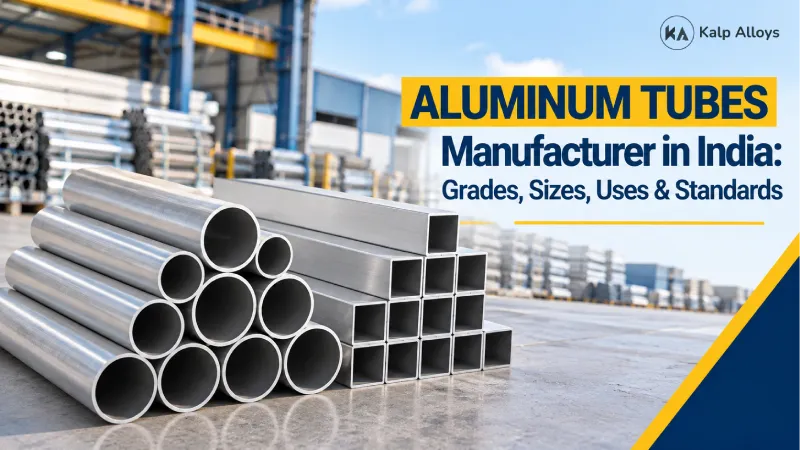
Outside diameter and wall thickness are the starting points for specifying round aluminum tubes. However, those measurements do not describe every detail needed for production or installation.
Even a slight variation in the outer diameter of a machined component can affect the precision of its fit with other parts during assembly. For a fabricated frame, straightness, cut length and permissible dimensional variation may be equally important.
Square and rectangular tubing also requires clear external dimensions, wall thickness and corner requirements where applicable.
At Kalp Alloys, we ask buyers to provide drawings when dimensional details cannot be communicated adequately through a standard product description.
As an Aluminum Tubes Manufacturer, we believe that confirming tolerances early helps prevent confusion when the supplied material reaches the fabrication stage.
ASTM Standards: Why Manufacturing Method Changes the Specification
Not all aluminum tubes are produced by the same process. Extrusion and drawing can result in different product characteristics, which is why ASTM maintains separate specifications.
ASTM B221 addresses extruded aluminum products, including tubes intended primarily for general-purpose applications.
ASTM B210/B210M covers drawn seamless aluminum tubes. Drawing is relevant when the required product specifications call for this manufacturing method.
ASTM B241/B241M applies to seamless aluminum pipe and seamless extruded tube, including products intended for pressure applications.
ASTM B429/B429M addresses extruded structural aluminum-alloy pipe and tube.
A structural tube should not be treated as suitable for pressure-containing service simply because its dimensions appear compatible.
As an Aluminum Tubes Exporter, we recommend specifying the applicable product standard rather than selecting it after the tube dimensions have already been finalised.
Where Are Aluminum Tubes Used in Industrial Projects?
The value of aluminum tubing often comes from its combination of manageable weight, fabrication characteristics and corrosion resistance in suitable environments.
In machinery and equipment manufacturing, aluminum sections may be used for support frames, guards and fabricated assemblies. Transportation-related applications can benefit from reduced component weight when the material meets the structural requirements.
Architectural projects may favour extruded tubing for its shape options and surface finish. Heat-transfer equipment represents another application area, although tubing for such service may require a dedicated product specification.
As an Aluminum Tubes Manufacturer, we recommend considering operating loads, joining methods, environmental conditions and expected service temperatures before choosing the material.
Common Specification Gaps That Buyers Should Avoid
A frequent purchasing issue is an enquiry that mentions only "aluminum tube" and its size. Without an alloy and temper, the required mechanical properties remain unclear.
Another problem arises when the manufacturing method is omitted. An extruded general-purpose tube may not meet the requirements of a drawing that specifically calls for drawn seamless tubing.
End conditions can also be overlooked. Buyers may need accurately cut lengths, controlled burrs or additional machining allowances, depending on the assembly.
As an Aluminum Tubes Exporter, we encourage customers to clarify these details before quotation, particularly when several components must fit into a completed assembly.
A well-defined specification outlines the required properties and characteristics of the final material rather than focusing solely on the tube’s basic geometry.
What Information Should Be Included in an Aluminum Tube RFQ?
A well-prepared request for quotation (RFQ) should clearly communicate the product specifications and requirements, enabling the supplier to select the appropriate item without relying on guesswork or assumptions.
Before submitting your enquiry, verify:
- Material: Aluminum grade and temper
- Product Shape: Available in circular, square, or rectangular tubular designs.
- Dimensions: Outside diameter, wall thickness and length
- Manufacturing method: Extruded, drawn or seamless, as required
- Standard: Applicable ASTM specification and edition
- Finish: Surface condition, cut ends and dimensional tolerances
- Documentation: Includes material certification records, inspection reports, and quantity verification details.
Our team can use these details to review the product requirement and clarify any missing information before preparing a quotation.
Why Choose Us?
At Kalp Alloys, we work with industrial buyers who require aluminum tubing for engineering and fabrication projects. As an Aluminum Tubes Manufacturer, we focus on understanding the material designation, tube dimensions, product standard and documentation requirements supplied by each customer. Our aluminum tube offering includes EN 10204 3.1 material certification, with 3.2 certification and third-party inspection available on request. We also support international enquiries where material identification, export coordination and clear purchasing specifications are important.
Conclusion
Choosing aluminum tubes involves decisions that extend beyond alloy selection. A project may require 6061 for certain mechanical properties or 6063 for extrusion-related advantages, but temper, dimensions and product standards remain essential considerations.
ASTM B221, B210, B241 and B429 address different tube manufacturing and application requirements. Buyers should identify the appropriate specification before confirming their order.
At Kalp Alloys, we believe that a successful purchase begins with a well-defined technical requirement. Reviewing the material, tolerances, manufacturing method and intended use helps buyers select tubing aligned with their project drawings and engineering specifications.
Looking for aluminum tubes for your next industrial project? Send our sales team your required aluminum grade, temper, dimensions, quantity and delivery destination for a quotation. Call us: +91 81608 73937
Email: sales@kalpalloys.com
Contact us today to discuss your aluminum tube requirements.
Frequently Asked Questions
What are the main aluminum tube grades suitable for different applications?
The primary aluminum tube grades include 6061, 6063, 5052, and 3003. Grade 6061 is known for its strength and machinability, making it ideal for load-bearing components. Grade 6063 is often chosen for its excellent extrusion characteristics and surface finish, popular in architectural applications.
What sizes of aluminum tubes can be sourced from an aluminum tubes manufacturer in India?
Aluminum tubes are typically specified by their outside diameter, wall thickness, and length. For precise fabrication, discussions about straightness, cut length, and permissible dimensional variations are also important. Buyers are encouraged to provide detailed drawings to avoid miscommunication.
Which ASTM standards are relevant for aluminum tube manufacturing?
Several ASTM standards regulate aluminum tube manufacturing, including ASTM B221 for extruded products, ASTM B210 for drawn seamless tubes, and ASTM B241 for seamless aluminum pipes. It's essential to specify the applicable standard based on the manufacturing method to ensure compliance with the required specifications.
What factors should be considered when choosing aluminum tubes for industrial applications?
Buyers should consider operating loads, joining methods, environmental conditions, and expected service temperatures when selecting aluminum tubes. The choice of alloy, temper, dimensions, and manufacturing method are also critical to ensure the material meets the project specifications.
How do I prepare an RFQ for aluminum tubes from an aluminum tubes supplier in India?
An RFQ should clearly detail the aluminum grade and temper, product shape, dimensions (outside diameter, wall thickness, and length), manufacturing method, applicable ASTM standard, and any finishing requirements. Providing comprehensive documentation helps the supplier deliver an accurate quotation and fulfill your project needs.