

Key Takeaways
- Understand the critical impact of alloy grade and heat treatment on seamless pipe performance.
- Kalp Alloys excels as an Alloy Steel Pipes Manufacturer, guiding buyers to select appropriate specifications for industrial use.
- Different ASTM A335 grades like P11, P22, and P91 cater to specific high-temperature applications.
- Evaluating pipe sizes and schedules is essential for ensuring structural integrity and performance in demanding systems.
- Use a comprehensive checklist to ensure accurate ordering of alloy steel seamless pipes or tubes to avoid confusion.
Kalp Alloys is a leading manufacturer and exporter of alloy steel pipes and tubes for industrial piping applications.
A seamless pipe may meet the required dimensions but still be unsuitable for its operating temperature or process conditions. The alloy grade, heat treatment and wall thickness all influence material performance. As an Alloy Steel Pipes Manufacturer, we help industrial buyers understand these specifications before selecting material for steam lines, process equipment and other demanding installations.
What Makes Alloy Steel Seamless Pipes Different?
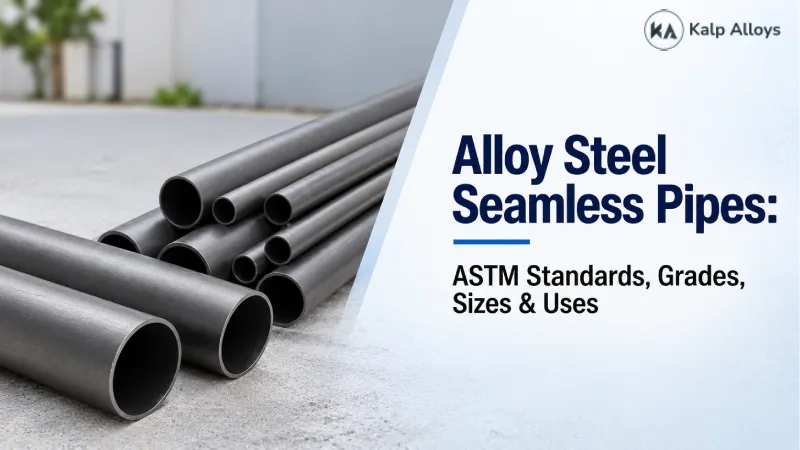
Unlike welded pipes, seamless pipes are produced without a longitudinal weld joint. Their manufacturing process typically involves forming a hollow section from solid steel, followed by further processing to achieve the required dimensions.
For elevated-temperature applications, chromium-molybdenum alloy steels are often considered because their composition provides properties suited to particular thermal and mechanical demands.
As an Alloy Steel Pipes Exporter, we recommend checking material grade and applicable standards rather than assuming seamless construction alone determines service suitability.
The absence of a weld seam does not replace the need for proper material selection and engineering calculations.
ASTM A335 P11, P22 and P91: Understanding the Grades
Different alloy compositions respond differently to prolonged heat exposure. This is particularly important when pipes carry steam or process fluids at elevated temperatures.
The following comparison highlights three commonly specified ASTM A335 grades.
| Grade | Material Characteristics | Typical Application Consideration |
|---|---|---|
| ASTM A335 P11 | 1.25Cr-0.5Mo chrome-moly steel | Selected steam and elevated-temperature process piping |
| ASTM A335 P22 | 2.25Cr-1Mo alloy composition | High-temperature steam and refinery applications |
| ASTM A335 P91 | Modified 9Cr-1Mo steel with controlled alloy additions | Demanding steam systems requiring higher creep strength |
P11 and P22 are not interchangeable merely because both belong to the chromium-molybdenum family. P91 introduces additional metallurgical and fabrication requirements, particularly for welding and heat treatment.
As an Alloy Steel Pipes Manufacturer, we recommend confirming the approved grade against the piping specification before procurement.
Which ASTM Standards Apply to Alloy Steel Pipes and Tubes?
The ASTM designation tells buyers which product requirements apply. Pipes intended for high-temperature pressure service are not automatically covered by the same specification as mechanical or heat-exchanger tubing.
- ASTM A335/A335M addresses seamless ferritic alloy-steel pipes intended for high-temperature applications.
- ASTM A213/A213M covers seamless ferritic and austenitic alloy-steel tubes for boilers, superheaters and heat exchangers.
- ASTM A519/A519M applies to specified grades of seamless carbon and alloy steel mechanical tubing.
- ASME B36.10 provides dimensional specifications for welded and seamless wrought steel pipes.
As an Alloy Steel Tubes Manufacturer and Alloy Steel Pipes Exporter, we recommend that buyers distinguish the intended product application before selecting the manufacturing standard.
Alloy Steel Seamless Pipe Sizes and Schedules
Pipe size and wall thickness must be evaluated together. A larger nominal diameter does not automatically indicate that a pipe can withstand higher internal pressure.
Industrial piping drawings generally specify nominal pipe size (NPS) and a wall-thickness schedule. Common designations include Schedule 40, Schedule 80 and Schedule 160, although applicable combinations depend on pipe size and specification.
At Kalp Alloys, we handle enquiries involving different pipe dimensions and wall-thickness requirements.
As an Alloy Steel Pipes Manufacturer, we encourage buyers to provide the NPS, schedule, required length and applicable dimensional standard instead of requesting material by nominal diameter alone.
Wall thickness must be established from the approved piping design and relevant allowances.
Alloy Steel Seamless Pipes vs Tubes
Although pipes and tubes may look similar, their purchasing specifications can differ.
Pipe requirements commonly use NPS and schedule designations. Tubing enquiries often identify outside diameter, wall thickness and manufacturing condition directly.
For boiler and heat-exchanger applications, tube specifications may also include additional requirements relating to mechanical properties, heat treatment and inspection.
As an Alloy Steel Tubes Exporter, we recommend identifying whether the requirement concerns process piping, boiler tubing or mechanical components before preparing an order.
Industrial Applications of Alloy Steel Seamless Pipes
Different industrial systems expose piping materials to different combinations of temperature, pressure and mechanical loading.
Typical application areas include:
- Power generation: Steam lines and selected high-temperature piping arrangements.
- Petrochemical plants: Process connections operating under specified thermal conditions.
- Refineries: Piping where chrome-moly material grades are required by the design.
- Boiler systems: Associated pipework and tubing selected under the applicable specification.
- Heat-transfer equipment: Alloy steel tubing used in suitable exchanger and superheater designs.
As an Alloy Steel Pipes Exporter and Alloy Steel Tubes Exporter, we support industrial enquiries where operating conditions and material specifications must be clearly communicated.
What Should Buyers Check Before Ordering?
A complete enquiry helps avoid confusion between material grades, product standards and dimensional requirements.
Use the following checklist when requesting alloy steel seamless pipes or tubes:
- ASTM material specification and grade
- Nominal pipe size or tube outside diameter
- Wall thickness or required schedule
- Seamless construction and manufacturing condition
- Required pipe length and quantity
- Heat-treatment and end-preparation requirements
- Material test certificates and inspection requirements
- Delivery destination and project documentation
For special applications, our Alloy Steel Tubes Exporter team recommends including engineering drawings and supplementary testing specifications.
Why Choose Us?
At Kalp Alloys, we support industrial customers purchasing alloy steel pipes and tubes for process, power-generation and engineering applications. As an Alloy Steel Pipes Manufacturer and Alloy Steel Tubes Manufacturer, we focus on understanding material grades, dimensional requirements and inspection expectations. Our product offering includes EN 10204 3.1 material certification, with 3.2 certification and third-party inspection available on request. We also work with international buyers seeking clearly specified piping materials, export coordination and documentation suited to their purchasing requirements.
Conclusion
Alloy steel seamless pipes serve important roles in industrial systems where temperature, pressure and material properties influence equipment design. ASTM A335 grades such as P11, P22 and P91 have different metallurgical characteristics and fabrication requirements.
Buyers should also distinguish between ASTM A335 pipes, ASTM A213 heat-exchanger tubing and ASTM A519 mechanical tubing. Selecting the correct standard, dimensions and material condition is essential.
At Kalp Alloys, we help customers communicate these requirements before procurement. As an Alloy Steel Tubes Manufacturer and Alloy Steel Pipes Exporter, our focus remains on understanding technical specifications and supporting suitable material sourcing decisions.
Looking for alloy steel seamless pipes or tubes for your industrial project? Share your ASTM grade, pipe size, schedule, quantity and delivery requirements with our sales team for a quotation. Call us: +918160873937 & Email: sales@kalpalloys.com. Contact us today to discuss your alloy steel piping requirement
Frequently Asked Questions
What are the main ASTM standards for alloy steel seamless pipes?
The primary ASTM standards for alloy steel seamless pipes include ASTM A335 for high-temperature applications, ASTM A213 for boilers and heat exchangers, and ASTM A519 for mechanical tubing. Each standard addresses specific product requirements, making it crucial for buyers to select the appropriate specification based on their application.
How do I choose the right alloy steel seamless pipe for my project?
To choose the right alloy steel seamless pipe, you should consider the ASTM material specification, nominal pipe size, wall thickness, manufacturing condition, and any specific heat treatment requirements. Providing detailed information such as pipe length and inspection certifications can also help ensure you get the right product.
What sizes and schedules are available for alloy steel seamless pipes?
Alloy steel seamless pipes come in various sizes and schedules, with common designations including Schedule 40, Schedule 80, and Schedule 160. The specific combination of size and schedule should be evaluated based on the piping design and application requirements.
What are the industrial applications of alloy steel seamless pipes?
Alloy steel seamless pipes are frequently used in industries such as power generation, petrochemicals, refineries, boiler systems, and heat-transfer equipment. Their ability to withstand high temperature and pressure makes them suitable for critical applications where material properties are essential.
Why should I choose Kalp Alloys as my alloy steel pipes manufacturer?
Kalp Alloys specializes in providing high-quality alloy steel pipes and tubes, with a focus on understanding material grades, dimensional requirements, and inspection expectations. We support industrial customers with tailored solutions, ensuring that they receive products that meet their specific needs.