

Key Takeaways
- Alloy steel flanges offer high mechanical strength, making them ideal for demanding industrial piping applications.
- Selecting the right alloy steel grade ensures better performance at elevated temperatures for various industries.
- Alloy steel flanges provide good resistance to wear and stress, enhancing the durability of piping components.
- Working with a reliable Alloy Steel Flanges Manufacturer guarantees adherence to specifications for quality and performance.
- Different flange types and configurations cater to specific piping systems, ensuring optimal connection reliability.
Kalp Alloys is a leading manufacturer and exporter of alloy steel flanges. In demanding industrial piping systems, flange selection can influence connection reliability, maintenance requirements, and service performance. An experienced Alloy Steel Flanges Manufacturer can provide products suited to the material, pressure, temperature, and operating conditions of the application.
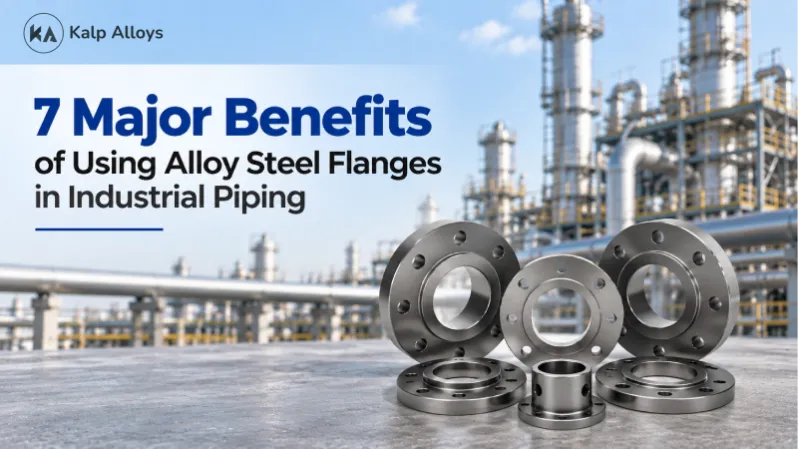
Alloy steel flanges are widely considered where higher mechanical strength and resistance to demanding service conditions are important. Their properties make them a practical choice for several industrial piping requirements.
1. High Mechanical Strength
One of the major benefits of alloy steel flanges is their mechanical strength. Alloying elements added to steel can improve properties such as strength and hardness compared with plain carbon steel grades, depending on the specific alloy and heat treatment.
This makes alloy steel flanges suitable for piping systems where components need to withstand significant mechanical loads and operating stresses.
A properly selected alloy steel flange provides a strong connection point between piping components while supporting demanding service conditions.
2. Better Performance at Elevated Temperatures
Many industrial processes involve elevated operating temperatures. In such systems, flange materials must retain appropriate mechanical properties under the expected service conditions.
Certain alloy steel grades are developed for applications involving higher temperatures, making them useful in sectors such as power generation, petrochemical processing, refining, and other process industries.
When specifying an alloy steel flange, the exact grade and service temperature should be considered rather than assuming that every alloy steel grade has the same temperature capability.
3. Good Resistance to Wear and Service Stress
Industrial piping components can be exposed to repeated mechanical stress, vibration, pressure fluctuations, and demanding operating environments. Material selection therefore plays an important role in component durability.
Depending on the alloy composition and grade, alloy steel can provide useful combinations of strength, toughness, hardness, and resistance to service-related wear.
Working with a reliable Alloy Steel Flanges Manufacturer helps buyers select the appropriate grade and flange design for the intended application instead of treating all alloy steel products as interchangeable.
4. Suitable for Demanding Industrial Applications
Alloy steel flanges are used across industrial environments where standard materials may not provide the desired combination of mechanical and thermal performance.
Typical application areas can include:
- Power generation plants
- Oil and gas processing facilities
- Refineries
- Petrochemical plants
- Chemical process industries
- High-temperature piping systems
The exact suitability depends on the flange material grade, design specification, operating conditions, and applicable piping requirements.
5. Improved Resistance to Specific Service Conditions
Another important advantage is the ability to select alloy compositions for particular service requirements. Different alloying elements can influence steel properties and its behaviour under different conditions.
For example, chromium, molybdenum, nickel, and other alloying additions can affect strength, hardenability, corrosion behaviour, and high-temperature performance, depending on the grade.
The benefit comes from selecting the right alloy steel grade for the actual operating environment, not simply from choosing an alloy steel flange by name.
This is why technical specifications should be reviewed carefully before purchasing industrial piping components.
6. Reliable Connection in Industrial Piping Systems
Flanges are used to create detachable connections between pipes, valves, pumps, fittings, and other equipment. A properly manufactured flange helps provide a suitable interface for bolting and gasket installation.
For demanding industrial systems, dimensional accuracy, material quality, flange face condition, and manufacturing consistency are important considerations.
A dependable Alloy Steel Flanges Exporter can support international buyers by supplying products manufactured according to the required specifications and documentation needs.
7. Flexibility in Flange Selection
Industrial piping does not involve one standard flange arrangement. Different projects require different flange types, dimensions, pressure classes, facing arrangements, and material grades.
Common flange types may include:
- Weld Neck Flanges
- Slip-On Flanges
- Blind Flanges
- Socket Weld Flanges
- Threaded Flanges
- Lap Joint Flanges
The appropriate type depends on the piping configuration, connection requirements, pressure conditions, and application.
This range of options allows engineers and procurement teams to select a flange configuration that fits the specific piping system.
Alloy Steel Flanges vs Other Steel Flanges
The right material depends on the operating environment and technical requirements. The following comparison gives a general view rather than treating one material as universally better.
| Factor | Alloy Steel Flanges | Carbon Steel Flanges |
|---|---|---|
| Mechanical strength | Can offer higher strength in selected grades | Suitable for many general applications |
| High-temperature service | Selected grades are suitable for elevated temperatures | Grade-dependent and application-specific |
| Alloy composition | Contains intentional alloying elements | Primarily iron and carbon with controlled additions |
| Application focus | Often selected for demanding service conditions | Widely used for general industrial piping |
| Material selection | Requires grade-specific evaluation | Also requires grade and application evaluation |
The comparison shows why flange selection should be based on service conditions rather than material names alone.
What Should Buyers Check Before Ordering?
Choosing the right industrial flange requires attention to technical details. Before placing an order, buyers can review the following:
- Material grade and specification
- Flange type and nominal size
- Pressure class or rating
- Facing and dimensional requirements
- Operating temperature and service conditions
- Required inspection and material documentation
- Applicable project or customer specifications
These details reduce the risk of receiving a component that does not match the piping design.
Why Manufacturer and Exporter Selection Matters
Industrial flanges are critical piping components, so supplier capability matters alongside product material. A manufacturer should be able to discuss material grades, dimensions, flange types, manufacturing requirements, and quality documentation clearly.
For overseas procurement, an Alloy Steel Flanges Exporter should also understand packaging, documentation, order specifications, and shipment requirements relevant to the destination market.
A technically capable supplier can make specification matching and procurement much easier for engineering and purchasing teams.
Why Choose Us
Kalp Alloys focuses on supplying alloy steel flanges for industrial piping requirements with attention to product specifications and application needs. Our approach is centred on helping buyers identify suitable flange types, material grades, dimensions, and technical requirements before production or supply. We work with domestic and international customers seeking dependable industrial piping components and provide a practical, specification-focused approach to alloy steel flange requirements.
Conclusion
Alloy steel flanges can provide several important benefits in industrial piping, particularly where strength, elevated-temperature capability, durability, and demanding service performance are required. However, the actual performance depends on selecting the correct alloy grade, flange type, dimensions, and specification for the application.
For engineering and procurement teams, working with an experienced Alloy Steel Flanges Manufacturer can simplify material and product selection. A capable supplier can also help overseas buyers meet technical and documentation requirements. At Kalp Alloys., we focus on supplying alloy steel flanges according to customer and application requirements, helping industrial buyers source suitable piping components for demanding environments.
Looking for a reliable supplier for industrial alloy steel flanges? Kalp Alloys. can support your requirement with specification-focused alloy steel flange solutions for industrial piping applications.
Call us: +91 81608 73937
Email: sales@kalpalloys.com
Frequently Asked Questions
What are the advantages of using alloy steel flanges in industrial piping?
Alloy steel flanges offer high mechanical strength, good resistance to wear and service stress, and improved performance under elevated temperatures. These properties make them suitable for demanding industrial applications where reliability and durability are essential.
Why should I choose an Alloy Steel Flanges Manufacturer?
Choosing an experienced Alloy Steel Flanges Manufacturer is crucial because they can provide tailored products that meet specific material, pressure, and temperature conditions. Their expertise ensures that the flanges are suitable for the operating environment and reduce the risk of failures.
What applications are suitable for alloy steel flanges?
Alloy steel flanges are commonly used in power generation plants, oil and gas processing facilities, refineries, and chemical industries. Their mechanical and thermal properties make them ideal for high-pressure and high-temperature piping systems.
How do I select the right alloy steel flange for my project?
Selecting the right alloy steel flange involves considering factors such as material grade, flange type, pressure class, and service conditions. Consulting with a reliable Alloy Steel Flanges Exporter can also help ensure that you choose a flange that meets your project's specific requirements.
Are all alloy steel flanges interchangeable?
No, not all alloy steel flanges are interchangeable. The specific grade, design, and application requirements must be evaluated to ensure compatibility and performance in the intended service conditions.