
Key Takeaways
- Aluminum tubes offer strength, durability, and corrosion resistance, making them ideal for various industrial applications.
- Selecting the right aluminum tube requires careful consideration of grade, dimensions, and environmental factors.
- Working with a reliable Aluminum Tubes Manufacturer ensures consistent quality and compliance with industry standards.
- Aluminum tubes are widely used in aerospace, automotive, marine, and HVAC sectors due to their robust performance.
- Quality control is essential to prevent failures caused by raw material inconsistencies during manufacturing.
Industrial projects require materials that combine strength, durability, lightweight performance, and corrosion resistance. Aluminum tubes have become one of the most preferred engineering materials because they offer an excellent balance of mechanical properties while remaining easy to fabricate and install. Their versatility makes them suitable for industries ranging from construction and transportation to aerospace, marine engineering, power generation, and manufacturing.
Selecting the right aluminum tubes is an important decision that directly impacts operational efficiency, product longevity, and project costs. Factors such as material grade, operating environment, dimensions, pressure requirements, and application type all influence the ideal tube selection. Working with an experienced Aluminum Tubes Manufacturer helps businesses obtain products that meet technical specifications and industry standards.
As a trusted supplier of industrial metal products, Kalp Alloys offers premium-quality aluminum tubes for a wide range of industrial applications. Companies looking for a reliable Aluminum Tubes Exporter often prioritize precision manufacturing, consistent product quality, and dependable delivery to support their projects worldwide.
What Are Aluminum Tubes and Why Do They Matter
Aluminum tubes are either seamless or ERW (Electric Resistance Welded) tubes or tubes that are welded and are made of aluminum alloys in the form of hollow cylinders or squares. They are prized for their unique combination of properties – being light, yet possessing high strength, they are also naturally rust and corrosion resistant and have a lower thermal conductivity than many other metals. Aluminum tubes are the material of choice wherever weight reduction, durability and heat management are all important at the same time.
Aluminum tubes have a far superior strength-to-weight ratio than carbon steel tubes or stainless steel tubes, that is why they’re extensively used in the aerospace or automotive sector. Their ability to resist atmospheric and chemical corrosion makes them suitable for use in marine, HVAC and outdoor industrial environments, where maintenance or replacement is needed only periodically. The reduced maintenance requirement throughout a project may represent actual material savings – even if the initial cost of the material itself is more expensive than a similar steel section.
Common Grades and What They Mean for Your Project
Not every aluminum tube is created alike, and the grade you use will have an impact on performance. The following are among the most popular grades:
- Grade 1100 – Known for excellent corrosion resistance and workability, often used where high formability is required.
- Grade 3003 – A general-purpose grade offering good strength and corrosion resistance, commonly used in HVAC and general fabrication.
- Grade 5052 – Popular for marine and structural applications due to its strong resistance to saltwater corrosion.
- Grade 6061 – A structural workhorse grade valued for its strength, weldability, and machinability, widely used in construction and automotive parts.
- Grade 7075 – A high-strength grade favored in aerospace applications where load-bearing performance is critical.
The proper grade selection is dependent on the environment in which the tube will perform, the mechanical loading it will encounter, and whether it will be welded, machined or shaped further during manufacturing. One of the most frequent (and preventable) mistakes on industrial sourcing projects is when the grade level and the application are mismatched.
Seamless, ERW, and Welded Aluminum Tubes: Understanding the Difference
Most often, aluminum tubes are provided in three shapes, each of which has a distinct function:
Seamless tubes :- are tubes that are extruded or drawn, and do not have a welded joint, so they are evenly strong all around. They are generally selected for high pressure or high stress applications where maintaining a uniform wall profile is important.
ERW (Electric Resistance Welded) tubes :- consist of aluminum strips being rolled into a tube and the seam being welded together with an electric current. It is an economical process which can also be used for general industrial and HVAC applications as it provides acceptable dimensional consistency.
Welded tubes:- in round and square shapes have the advantage of being versatile in size and shape and yet provide high-quality mechanical properties in structural, architectural and other applications.
Key Applications Across Industries
Aluminum tubes are used across a wide range of sectors because of their versatility:
- Aerospace – lightweight structural components, fuel and hydraulic lines
- Automotive – chassis parts, exhaust systems, heat exchangers
- Marine – piping and structural framework exposed to saltwater
- HVAC – refrigerant lines, ducting, and heat exchange components
- Chemical processing – piping systems where corrosion resistance is essential
- Construction and general engineering – railings, frames, and structural supports
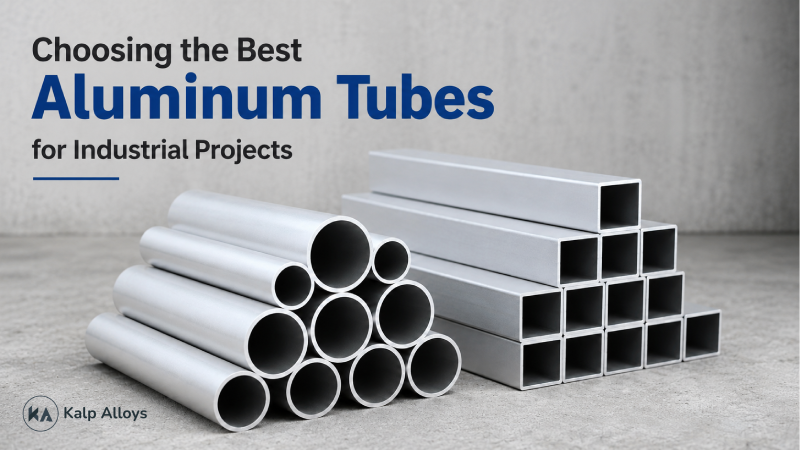
With such a broad range of applications, size and schedule flexibility is important. The wall thickness of tubes is generally offered from 15 NB to 600 NB, and comes in a variety of schedules from SCH 5S to SCH 160, providing the flexibility for the engineer to specify the wall thickness appropriate to the pressure and load requirements. Most piping and structural applications are better served by the round profile, while the square configuration is usually used in frames, railings and flat mounting surfaces in architectural applications.
How to Choose the Right Aluminum Tube for Your Project
Selecting the right tube is not just about picking a grade off a datasheet. Consider these factors before finalizing your specification:
1. Application environment – Will the tube be exposed to saltwater, chemicals, or extreme temperatures? This determines the grade and finish required.
2. Mechanical load – Structural applications need higher-strength grades like 6061 or 7075, while general fabrication can often use 3003 or 1100.
3. Fabrication method – If the tube will be welded, bent, or machined further, workability becomes as important as raw strength.
4. Size and schedule – Confirm the required NB size and schedule early, since wall thickness directly affects both performance and cost.
5. Supplier reliability – Consistent quality, proper certification, and on-time delivery from your Aluminum Tubes Manufacturer matter as much as the technical specification itself.
6. Documentation and traceability – Mill test certificates and batch traceability protect you if a dispute or field failure ever needs to be investigated, so ask for this upfront rather than after an order is placed.
Why Quality Control Is Non-Negotiable
A great percentage of the time the failure is not caused by a design defect but rather is in reality caused by the inconsistency of the raw material or poor manufacturing control. To ensure consistent quality, the Aluminum Tubes Manufacturer performs quality checks for dimensional accuracy, surface finishing and mechanical properties at various production stages. The same level of scrutiny is applied to the final assembly, such as a fuel line on an aircraft, or a structural frame in a chemical plant.
At the international level, when the Aluminum Tubes Exporter is the key source of your supply, it is even more important because the products may have to travel great distances until they reach the project site and any inconsistencies will be expensive to rectify later. The tubes will also reach the export destination in the same condition they left the factory with if there are proper packaging, moisture protection and accurate labelling during export.
Packaging, Certification, and On-Time Delivery
Technical specification is only half the story once an order moves toward dispatch. Aluminum tubes need to be packed in a way that protects the surface finish and prevents dents or scratches during transit, especially on long international routes where cargo is handled multiple times before it reaches site. Wooden crating, edge protectors, and moisture-resistant wrapping are standard practice for any shipment that has to travel by sea.
Certification matters just as much as packaging. Mill test certificates, dimensional inspection reports, and, where required, third-party inspection agency approval give the buyer a documented record of what was actually supplied. This paperwork becomes essential if a batch ever needs to be traced back to its production run, and it is worth confirming what documentation is included before an order is confirmed rather than after the tubes have shipped. On-time delivery, in turn, depends on a supplier that plans production and logistics together rather than treating them as separate steps, so that a confirmed lead actually holds once the order is placed.
Why Choose Us
Kalp Alloys stands as a trusted supplier of high-quality ferrous and non-ferrous metal products designed for diverse industrial applications, with aluminum tubes forming a core part of that offering. The company works with an extensive product range spanning stainless steel, carbon steel, copper, aluminum, and specialty alloys, backed by strict testing at every stage of production to support durability and performance. Products are engineered for application-specific needs across structural, chemical, and marine environments, with custom manufacturing options available for sizes, grades, and finishes tailored to individual project requirements. An efficient supply chain supports fast and accurate order dispatch, while an experienced technical team is available to guide material selection for even the most demanding specifications. This combination of range, quality discipline, and responsive service is what makes this company a dependable partner for industrial buyers who need aluminum tubes and related products delivered right the first time.
Conclusion
Selecting the right aluminum tubes comes down to matching grade, construction type, and size to the real demands of your project, then sourcing from a supplier that backs its products with consistent quality control. Aluminum tubes offer a strength-to-weight advantage and corrosion resistance that few materials can match, making them suitable for aerospace, automotive, marine, HVAC, and general engineering use. Working with an experienced Aluminum Tubes Manufacturer and Aluminum Tubes Exporter removes much of the guesswork from sourcing, giving project teams confidence that every tube delivered will perform as specified, on time and to standard, across grades, sizes, and construction types suited to their project.
Need dependable Aluminum Tubes for your industrial project? Call Kalp Alloys at +91 8160873937 or email info@kalpalloys.com for grades, sizes, and a quick quote.
Frequently Asked Questions
What are the key factors to consider when choosing aluminum tubes for industrial projects?
When selecting aluminum tubes, consider application environment, mechanical load, fabrication method, size and schedule, and supplier reliability. Each factor influences performance, cost, and overall project efficiency.
How do I know which grade of aluminum tube is suitable for my application?
The choice of aluminum tube grade depends on factors like exposure to corrosive environments, the mechanical load it will bear, and whether it will be welded or machined. Common grades include 1100 for general use and 7075 for aerospace applications.
What is the difference between seamless and ERW aluminum tubes?
Seamless aluminum tubes are extruded without any welded joints, making them ideal for high-pressure applications. In contrast, ERW tubes are formed from rolled aluminum strips and welded, offering a more economical option for general industrial use.
Why is quality control important when sourcing from an aluminum tubes manufacturer?
Quality control is critical as inconsistencies in raw materials can lead to failures in the final product. Manufacturers perform checks for dimensional accuracy and mechanical properties to ensure that every tube meets the required standards.
What should I expect from an aluminum tubes exporter in terms of packaging and delivery?
An aluminum tubes exporter should provide proper packaging to protect the tubes during transit, including moisture-resistant wrapping and wooden crating. Additionally, they should offer timely delivery backed by accurate documentation to ensure traceability.