
Key Takeaways
- Understanding project requirements helps in selecting the right carbon steel pipes for efficiency and cost-effectiveness.
- Evaluate the grade of carbon steel pipes based on application demands for long-term reliability.
- Choose a carbon steel pipes manufacturer with a wide range of sizes and schedules to meet diverse project needs.
- Consider the manufacturing process—seamless, ERW, or welded—to ensure pipes align with pressure and application specifics.
- Supplier reliability and timely delivery are crucial for the success of your industrial projects involving carbon steel tubes.
Selecting the right carbon steel pipes is one of the most important decisions in any industrial, commercial, or infrastructure project. Whether the application involves transporting fluids, supporting structural frameworks, or handling high-pressure operations, choosing the correct pipe can directly influence the efficiency, safety, and lifespan of the entire system.
With numerous grades, dimensions, manufacturing methods, and industrial standards available, buyers often find it challenging to determine which carbon steel pipes best match their project requirements. Understanding the essential selection factors helps reduce maintenance costs, improve operational performance, and increase the overall reliability of the installation.
As a trusted name in the metal industry, Kalp Alloys supplies high-quality carbon steel pipes and tubes for a wide range of industrial applications. Businesses searching for a reliable Carbon Steel Pipes Manufacturer or dependable Carbon Steel Pipes Exporter often prioritize quality, consistency, and industry compliance to achieve long-term performance.
Why Carbon Steel Pipes Matter in Industrial Projects
Carbon Steel pipes are one of the most popular piping materials in heavy industries. These are favored by engineers and procurement teams because of their strength, low cost and high-temperature and pressure performance.
Carbon steel pipes are used in boilers, refineries, construction projects, power generation facilities, and many other crucial applications. A reliable Carbon Steel Pipes Exporter is aware of these different needs and delivers pipes designed to satisfy the requirements of every application, instead of a single “one size fits all” solution.
Understanding Your Project Requirements First
Before you approach any supplier, it helps to have clarity on what your project actually needs. Ask yourself the following questions:
- What is the operating pressure and temperature range?
- Will the pipes carry corrosive fluids, gases, or steam?
- What size range and schedule thickness does your piping layout call for?
- Do you need seamless pipes, ERW pipes, or welded pipes?
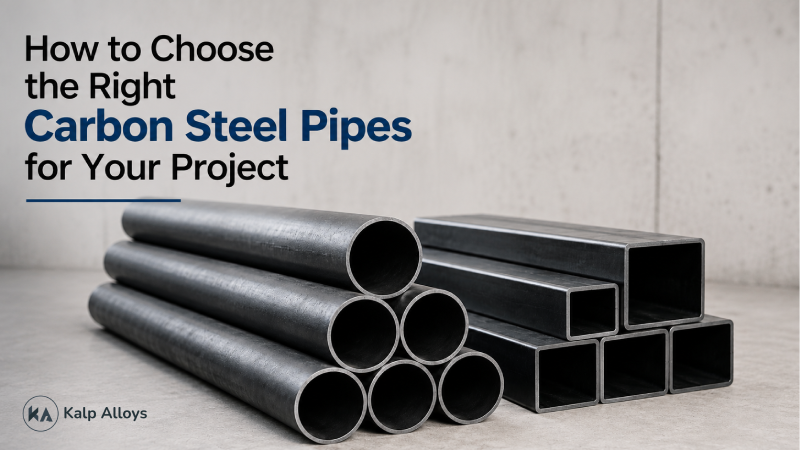
- Are you looking for round or square sections?
Once these answers are clear, it becomes much easier to shortlist a Carbon Steel Tubes Manufacturer who can supply pipes and tubes matching your exact technical specifications instead of settling for generic stock.
Key Factors to Consider When Choosing Carbon Steel Pipes
1. Grade Selection
There are several different grades of carbon steel pipes, each suited for a different application. Common grades range from A53 Gr A/B to A106 Gr A/B/C, and API 5L Gr B through X70 for line pipe applications. Alloy steel grades like A335 P1, P5, P9, P11, P12, P22, P23 and P91 are often used for higher temperature applications.
The choice of the grade will depend on the pressure class; temperature of the fluid or gas being carried and the type of fluid or gas. A carbon steel pipes manufacturer with knowledge will advise you on the grade that you might need for your process conditions and will not force a grade just because it is the least difficult to manufacture.
2. Size and Schedule Range
Project piping systems can range from small instrumentation pipes to large diameter transmission lines. You can be adaptable when your project grows because you can engage with a supplier who can offer a wide range of sizes, from small nominal bores to huge diameters, as well as a whole spectrum of schedules, from thin wall to extra heavy wall.
It is one of the reasons why the procurement teams prefer an established Carbon Steel Tubes Exporter with a wide range of sizes and schedules as opposed to a narrow range of inventory.
3. Manufacturing Process: Seamless vs ERW vs Welded
Carbon steel pipes are usually manufactured as seamless pipes, ERW (Electric Resistance Welded) pipes or welded pipes. For high pressure and critical applications, seamless pipes are usually preferred as they are free from seam welding. However, welded pipes and ERW pipes are suitable for lower pressure and structural applications, which are cost-effective.
If you have an idea for a project that you would like to manufacture, knowing which one is the best option for your project can save you money from ordering and paying for unnecessary specifications or from underspecifying pipes for rigorous environments.
4. Surface Finish and Dimensional Accuracy
This precision in outer diameter, wall thickness and surface finish is directly related to the ability of pipes to fit into your piping system, as well as their service life.
A well-known Carbon Steel Tubes Manufacturer checks each batch before dispatching for the size, thickness and accuracy of the finish, to minimize on-site fitting problems and rework.
5. Certification and Testing
In certain industries such as oil & gas, power generation, and refineries, material certifications are a mandatory requirement.
When purchasing this material, make sure to choose a supplier that includes suitable documentation and testing reports with the product, ensuring that your project remains compliant with industry standards and client specifications.
6. Application-Specific Needs
The requirements for pipes in various industries vary. Pipes with high heat and pressure cycle resistance are required for refineries. For continuous high-temperature service, boilers need pipes that are rated for such service. Oil & gas pipelines require a long distance, corrosion resistant and strong material.
For construction or structural projects, the focus could be on cost efficiency and ease of fabrication. A good Carbon Steel Pipes Exporter should know the type of project you’re working on, and make a recommendation based on that.
7. Supplier Reliability and Delivery Timelines
The best pipe specification will be of little help if it is late. Refinery, power plant and construction schedules are usually running tight, and it is as important to work with a supplier that has proven consistent delivery on time as is the technical specification sheet.
Carbon Steel Tubes: A Closer Look
Carbon steel tubes are used for structural, mechanical and industrial applications, and when dimensional precision and surface finish are more important than transport of liquids and gases. A trusted Carbon Steel Tubes Exporter supplies tubes with a smooth surface finish, which have long working life, and can be used for the frame, mechanical assemblies, and structural parts.
From round tubing to square tubing, having a supplier that understands both pipes and tubes under one roof can make your procurement process much easier.
Common Applications of Carbon Steel Pipes and Tubes
- Oil & gas exploration and transmission pipelines
- Refineries and petrochemical plants
- Boilers and power generation units
- Industrial pipeline networks
- Structural and mechanical fabrication
- Construction and infrastructure projects
Because these applications span such different operating environments, sourcing from a single, experienced Carbon Steel Pipes Manufacturer that also functions as a Carbon Steel Tubes Manufacturer can save you the trouble of coordinating between multiple vendors for a single project.
How Kalp Alloys Fits Into Your Project
Kalp Alloys has built its reputation as a dependable Carbon Steel Pipes Manufacturer and Carbon Steel Pipes Exporter, supplying products that meet the needs of modern infrastructure and heavy engineering projects. The company offers pipes across a wide range, multiple schedules, and both carbon steel and alloy steel grades, manufactured as seamless, ERW, or welded, in round and square forms. Beyond pipes, Kalp Alloys also operates as a reliable Carbon Steel Tubes Manufacturer and Carbon Steel Tubes Exporter, supplying tubes suited for structural, mechanical, and industrial applications with attention to finish and long-term performance.
Why Choose Us
Kalp Alloys stands as a trusted supplier of high-quality ferrous and non-ferrous metal products designed for diverse industrial applications, with every carbon steel pipe and tube manufactured using advanced methods and inspected closely for accuracy in size, thickness, and finish. The company offers an extensive product range spanning stainless steel, carbon steel, alloy steel, and other advanced materials, backed by strict quality testing at every stage of production. With application-specific solutions engineered for industrial, structural, and chemical needs, along with custom manufacturing options for tailored sizes and grades, Kalp Alloys supports clients through a reliable, on-time delivery system and an experienced technical team that helps guide the right material selection for each project. This combination of technical depth, consistent quality, and responsive service is what has allowed Kalp Alloys to serve clients across multiple regions and industries as a preferred name in piping and engineering raw materials.
Conclusion
Choosing the right carbon steel pipes involves more than picking a size off a catalogue. Grade, schedule, manufacturing process, surface finish, and supplier reliability all play a role in how well your piping system performs over time. Working with an experienced manufacturer who understands your industry’s specific demands helps you avoid costly mistakes down the line. Kalp Alloys brings together a wide product range, strict quality checks, and responsive service to support projects across oil & gas, refineries, power plants, and industrial infrastructure, making the selection process considerably easier for procurement and engineering teams alike.
Need help selecting the right carbon steel pipes or tubes for your next project? Reach out to Kalp Alloys today for expert guidance and a quick, reliable quote. Call us: +91 8160873937 Email: info@kalpalloys.com
Frequently Asked Questions
What factors should I consider when choosing carbon steel pipes for my project?
When selecting carbon steel pipes, consider the grade, size, schedule, manufacturing process, surface finish, and supplier reliability. Each of these factors can significantly impact the performance and lifespan of your piping system.
How do I determine the right grade of carbon steel pipes for my application?
The right grade of carbon steel pipes depends on the specific conditions of your application, including pressure, temperature, and the type of fluid being transported. Consulting a knowledgeable Carbon Steel Pipes Manufacturer can help guide your selection.
What is the difference between seamless and welded carbon steel pipes?
Seamless carbon steel pipes are manufactured without seams, making them suitable for high-pressure applications due to their strength and integrity. Welded pipes, including ERW, are typically used for lower pressure applications and are more cost-effective.
Why is it important to choose a reliable carbon steel pipes exporter?
Choosing a reliable carbon steel pipes exporter ensures consistent quality, on-time delivery, and compliance with industry standards. This is crucial for maintaining project schedules and meeting specific operational requirements.
What applications commonly use carbon steel tubes?
Carbon steel tubes are frequently used in structural, mechanical, and industrial applications, including the construction of frames, mechanical assemblies, and pipelines. They are preferred for their strength and dimensional precision.