
Key Takeaways
- Grade 5 Ti-6Al-4V rules 550°C aerospace applications with 120 ksi strength retention.
- Grade 7 palladium counters hydrogen embrittlement in steam and acidic environments.
- TiO2 passivation thrives above 500°C, providing self-healing properties for surface flaws.
- Low density halves the weight compared to steel while maintaining matching strength.
- Source from Titanium Flanges Exporter Kalp Alloys for DIN/ASTM certified custom solutions.
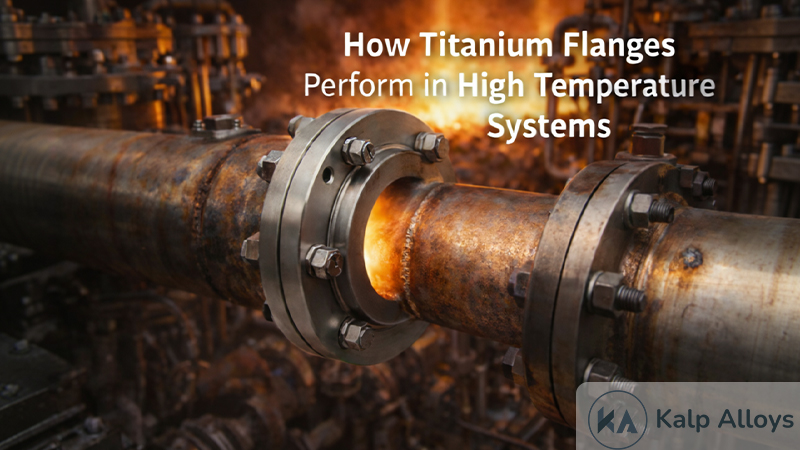
A titanium flange glowing red-hot at 600°C suddenly cracks, unleashing superheated steam that cripples an aerospace test rig and delays millions in certification. Titanium Flanges rewrite this nightmare, harnessing lightweight strength and corrosion defiance to conquer extreme heat where steels warp and alloys oxidize. As a leading Titanium Flanges Manufacturer, Kalp Alloys forges these gamechangers for chemical plants, marine drives, and high-temp piping that demand zero compromise.
Core Properties of Titanium Flanges
Titanium Flanges derive prowess from pure titanium or alpha-beta alloys like Grade 2, 5, 7, and 9, boasting density half that of steel yet matching yield strengths above 120 ksi. Their hexagonal close-packed structure resists creep up to 500°C, while passive TiO2 films repel oxidation far beyond stainless limits. Kalp Alloys, a premier Titanium Flanges Exporter, machines them to DIN, ASTM, and BS specs for seamless integration in custom-sized systems from fractional inches to process giants.
At elevated temperatures, titanium maintains modulus stability, preventing resonance in turbine casings. Grade 5’s vanadium-aluminium mix elevates rupture life tenfold over pure grades, critical for sustained 400°C exposures. These traits position titanium flanges as linchpins in environments where weight savings amplify performance.
High-Temperature Strength Mechanisms
Titanium’s alpha phase dominates below 900°C, granting superior creep resistance versus beta-titanium’s softening. Grade 7’s palladium doping accelerates repassivation in oxidizing air, sustaining ductility after 1000-hour 550°C holds. Kalp Alloys heat-treats to fine alpha-beta dispersions, yielding flanges that endure thermal fatigue cycles without microcracking.
Yield drops modestly—Grade 2 holds 40 ksi at 400°C versus 50 ksi ambient—outpacing nickel alloys’ sharper declines. This persistence powers Titanium Flanges Manufacturer Kalp Alloys’ output for jet engine bleed air ducts, where every gram and degree counts.
Oxidation and Corrosion at Heat
TiO2 scales thicken protectively above 300°C, self-healing scratches unlike chromia spallers on Inconel. In steam at 600°C, Grade 9 forms rutile barriers, slashing intergranular attack 90% versus stainless. Seawater-vapor mixes challenge lesser metals, but titanium flanges shrug off pitting per ASTM G48 even post-heat tinting.
Hydrogen embrittlement lurks above 300°C in reducing gases; palladium-alloyed Grade 7 mitigates absorption. Kalp Alloys applies vacuum annealing, delivering flanges primed for chemical reactors cycling 200-500°C.
Grades Tailored for Thermal Extremes
Grade 2 offers weldability for cryogenic-to-hot transitions in LNG vaporizers hitting 400°C peaks. Grade 5 (Ti-6Al-4V) dominates aerospace at 550°C, its alpha precipitates locking dislocations. Grade 7 excels in chloralkali plants, palladium boosting crevice corrosion thresholds amid 450°C brine vapor.
Grade 9 bridges cost-performance for marine exhausts, alpha-beta balance yielding 90 ksi at 400°C. As Titanium Flanges Exporter Kalp Alloys stocks all, matching grades to your thermal profile.
Performance in Key Flange Types
Weld neck titanium flanges taper hubs distribute 600°C root stresses, vital for Grade 5 compressor flanges. Socket welds minimize crevice oxygen starvation in heat soaks, Grade 2 preferred. Blind flanges seal hydrotests at 500°C equivalents, titanium’s low expansion aiding gasket seating.
Threaded variants skip welds in retrofit sensors, lap joints enable bolt inspection post-heat cycles. Custom sizes via forging suit non-standard manifolds, all per ASME pressure-temperature curves adapted for titanium.
Standards Driving Reliability
ASTM B381 governs forging, alpha-beta stabilization at 800-950°C refining grains for isotropy. DIN 86090 flanges prioritize European aero tolerances, BS 4504 refines metric bolting. Kalp Alloys performs helium leak checks post-heat, ultrasonic flaw detection to 0.5% wall.
Hardness holds BHN 300 minimum after exposure, fatigue limits exceed 10^7 cycles at 400°C stress-relieved.
Real-World High-Temp Applications
Chemical plants deploy Grade 7 in titanium-lined autoclaves at 500°C acids, zero downtime from oxidation. Marine gas turbines use Grade 5 intercooler flanges, weight cuts boosting fuel economy 5%. Aerospace test stands feature Grade 9 manifolds surviving 600°C shock transients.
Motorsport exhausts leverage Grade 2 for 30-lap 550°C endurance, bicycles titanium bottom bracket flanges dissipate welding heat sans distortion. Titanium Flanges Manufacturer Kalp Alloys powers these with bespoke solutions.
Selection Pitfalls in Heat Service
Overlooking alpha-case from contaminated heats embrittles surfaces—vacuum process exclusively. Galling plagues titanium-to-steel bolting at heat; apply MoS2 coatings. Weld dilution with carbon steels forms brittle TiC; butter with Grade 2.
Exceeding 600°C risks lamellar twins weakening alpha plates. Partner proven Titanium Flanges Exporter Kalp Alloys for mitigated risks.
Why Choose Us
we’re a trusted supplier of top quality ferrous and non-ferrous metal products that cater to a lot of different industries. Our focus is on getting the job done right – delivering accurate, high-performance, and customer-centric work. You can count on us to provide a broad range of materials along with strict quality control and dependable delivery times. Whether your project calls for stainless steel, carbon steel, alloy steel, duplex and super duplex, nickel alloys, or titanium, we’ve got you covered with tailored specs, timely support & project guidance every step of the way.
With an arsenal of materials like stainless steel, carbon steel, alloy steel, duplex & super duplex, nickel alloys, titanium, copper, aluminium and other advanced alloy materials, our aim is to supply the best products possible, and back it up with expert guidance to help you achieve great consistent results across all applications.
Conclusion
Titanium Flanges rule supreme in high temperature applications thanks to some seriously impressive properties like creep-resistant alpha structures, a built-in defence system (TiO2 oxidation shields) and of course being super lightweight – meaning grade 2/5/7/9 held up at 600°C in the chemical, marine, aerospace & motorsport worlds. Whether its weld necks in the turbine roots or custom forgings in autoclaves, they cut weight, repel corrosion and last longer than the rest. We at Kalp Alloys are perfectionists and nail this performance with standards-grade precision.
For specifics on “How Titanium Flanges Perform in High Temperature Systems,” reach Titanium Flanges Manufacturer or Titanium Flanges Exporter Kalp Alloys at +91 8160873937 or info@kalpalloys.com.
FAQs
What temperature maximum for titanium flanges?
Grade 5 handles continuous 550°C service reliably.
Which grade suits chemical plants?
Grade 7 resists acidic vapors up to 500°C.
Are titanium flanges weldable at heat?
Yes, Grade 2 offers excellent hot workability.
Standards for titanium flanges?
ASTM B381, DIN, BS compliance standard
Contact Titanium Flanges Manufacturer Kalp Alloys?
+91 8160873937 or info@kalpalloys.com now.