
Key Takeaways
- Cupro nickel C706 excels in seawater with 50 W/mK thermal conductivity.
- Aluminium bronze C954 yields 90 ksi, making it ideal for structural marine roles.
- Admiralty brass effectively resists scaling in low-pressure heat exchangers.
- Phosphor bronze damps vibration while conducting heat superbly.
- Rely on Copper Alloys Flanges Exporter Kalp Alloys for ASTM-certified grades.
Envision a heat exchanger in a desalination plant failing due to corrosion-induced leaks, crippling water production and inflating repair costs sky-high. Copper Alloys Flanges emerge as unsung heroes, fusing exceptional strength with superior thermal conductivity to power marine, power, and industrial systems without compromise. As a premier Copper Alloys Flanges Manufacturer, Kalp Alloys engineers these components for unmatched durability in corrosive realms, transforming potential vulnerabilities into reliable performance pillars.
Defining Copper Alloys Flanges
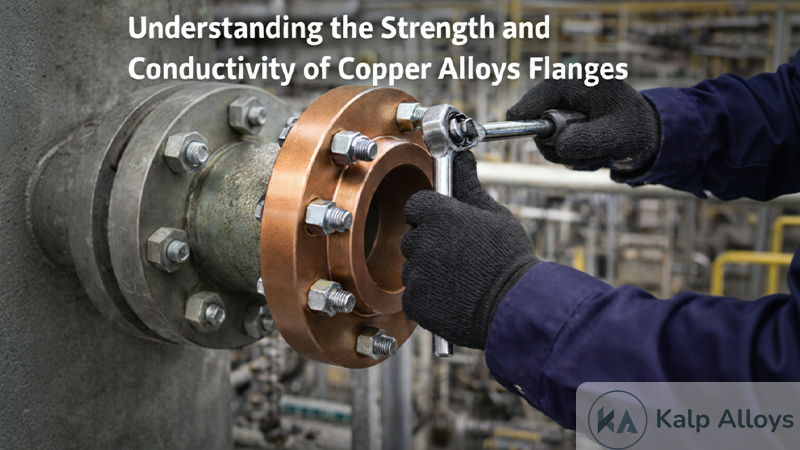
Copper Alloys Flanges anchor piping systems where corrosion meets heat transfer demands, blending copper with zinc, nickel, aluminium, or tin for tailored properties. These flanges deliver outstanding seawater resistance alongside high electrical and thermal conductivity, critical for condensers and marine propulsion. Kalp Alloys, a distinguished Copper Alloys Flanges Exporter, forges them to exacting standards, balancing malleability for formability with robustness for pressure containment.
Brass and admiralty brass variants shine in low-pressure cooling circuits, while cupro nickel dominates desalination intakes. Aluminium bronze adds tensile punch for propeller shafts, and phosphor bronze resists fatigue in vibrating setups. This alloy diversity equips copper alloys flanges for fluid handling where steel succumbs to dezincification or erosion.
Unpacking Mechanical Strength
Strength in copper alloys flanges stems from controlled alloying—aluminum bronze C95400 boasts 90 ksi yield, rivaling mild steel yet weighing half as much. Phosphor bronze C52100 absorbs shocks via 15% elongation, ideal for pump discharges under pulsation. Kalp Alloys heat-treats these for optimal grain structure, yielding flanges that withstand 500 psi bursts without rupture.
Tensile values climb with beryllium copper additions, hitting 120 ksi for aerospace hydraulics, but cost trade-offs Favor C706 cupro nickel at 50 ksi for bulk marine use. Factor cyclic loading: admiralty brass fatigues slower than pure copper, extending service in tidal flows. As a leading Copper Alloys Flanges Manufacturer, Kalp Alloys certifies strengths per ASTM, matching flanges to dynamic plant stresses.
Mastering Thermal and Electrical Conductivity
Copper Alloys Flanges conduct heat at 200-400 W/mK, dwarfing stainless steels 15 W/mK, slashing exchanger approach temperatures by 20%. Cupro nickel C71500 transfers 50 W/mK while repelling biofouling, perfect for condenser tube sheets where scaling hikes energy bills. Electrical conductivity tops 20% IACS in brass, grounding stray currents in shipboard power grids.
Conductivity drops with alloying—heavy nickel in C706 halves pure copper’s rate but doubles corrosion life. In power plants, phosphor bronze flanges link busbars, minimizing resistive losses. Kalp Alloys optimizes microstructures for dual conductivity-strength, vital where copper alloys flanges bridge thermal circuits and structural loads.
Corrosion Resistance Mechanisms
Seawater pits carbon steel yearly, but copper alloys flanges form passive oxide films—cupro nickel’s iron boosts this protectiveness against velocity erosion up to 3 m/s. Admiralty brass C44300 resists 1% chloride streams via arsenical tweaks curbing dezincification. Aluminium bronze C95800 laughs off sulphides in harbours, its kappa phase shielding cavitation.
Biofouling clings less to copper’s oligodynamic effect, killing microbes on contact. Galvanic series placement spares aluminium bronzes from anode sacrifice against propellers. Kalp Alloys, as a trusted Copper Alloys Flanges Exporter, applies inhibitors during forging, yielding flanges for 30-year desalination immersion.
Grades and Their Specialized Roles
Cupro nickel C70600 and C71500 rule marine risers, blending 90/10 or 70/30 ratios for flow velocity tolerance. Brass C44300 admiralty suits HVAC chillers, cheap yet resilient to scaling. Aluminium bronze C954/C955 handles propeller struts, C958 propeller shafts.
Phosphor bronze C510/C521 dampens vibration in compressor flanges. Kalp Alloys stocks these grades, a go-to Copper Alloys Flanges Manufacturer for spec-matched supply.
Flange Types Tailored to Service
Weld neck copper alloys flanges taper for root reinforcement in heat exchanger bonnets, cupro nickel variants preferred. Socket weld fills crevices against crevice corrosion in desalination. Blind caps pressure-test admiralty brass headers.
Slip-on eases alignment in retrofit condensers, threaded skips welds in instrumentation. Lap joint aids disassembly in fouled oil coolers. Sizes span ½” to 48” NB, Class 150-1500 per ASME B16.5.
Standards, Testing, and Fabrication
ASME B16.5 dictates facings for RTJ or flat gaskets, B16.47 scales up giants. ASTM B148 governs aluminium bronze chemistry, forging at 800°C refines C954 grains. Kalp Alloys de-burrs to Ra 3.2 machined finishes, hydrotests to 1.5x rating.
PMI confirms alloy, ultrasonic hunts voids, hardness verifies anneal. Polished surfaces boost hygiene in potable lines.
Applications Driving Demand
Marine desalination thrives on cupro nickel flanges in MSF evaporators, slashing brine corrosion. Power condensers use admiralty brass for vacuum integrity. Oil coolers deploy aluminium bronze against hydrocarbon blends.
Heat exchangers in refineries pick phosphor bronze for thermal shocks. Copper Alloys Flanges Exporter Kalp Alloys fuels these sectors with ready stocks.
Pitfalls and Selection Wisdom
Overfocusing cupro nickel above 4 m/s impingement-attacks; throttle flows. Pairing dissimilar metals sparks galvanic—insulate bronze from steel. Skipping dezincification tests dooms brass in ammonia.
Age-softening phosphor bronze demands low-heat welds. Source vetted Copper Alloys Flanges Manufacturer Kalp Alloys to sidestep fakes.
Why Choose Us
Kalp Alloys stands as a trusted supplier of high-quality ferrous and non-ferrous metal products designed for diverse industrial applications. With a strong focus on precision, performance, and customer satisfaction, we offer a wide range of materials, strict quality control, and reliable delivery. Our experienced team provides every requirement with the right solution, supported by customized specifications and timely service. Whether your project demands Stainless steel, Carbon steel, Alloy Steel, Duplex and Super Duplex, Nickel Alloys, Titanium, Copper Alloys, Aluminium and other advanced alloy materials, Kalp Alloys delivers dependable products and expert support to help you achieve consistent, long-lasting results across all applications.
Conclusion
Copper Alloys Flanges master strength via high-tensile bronzes and conductivity through cupro nickel matrices, powering marine, desalination, power, and heat transfer realms against corrosion onslaughts. Cupro nickel fends seawater, admiralty brass scales chillers, aluminum bronze fortifies shafts—all per ASME with Kalp Alloys’ precision. These flanges cut downtime, boost efficiency, and endure decades.
For insights into “Understanding the Strength and Conductivity of Copper Alloys Flanges,” contact Copper Alloys Flanges Manufacturer or Copper Alloys Flanges Exporter Kalp Alloys at +91 8160873937 or info@kalpalloys.com.
FAQs
What sizes cover copper alloys flanges?
½” NB to 48” NB spans instruments to process lines.
Which alloy for desalination plants?
Cupro nickel C71500 combats biofouling and erosion.
Do copper alloys flanges meet ASME standards?
Yes, B16.5 and B16.47 for pressure classes 150-1500.
Best for heat exchangers?
Admiralty brass C44300 for cost-effective cooling.
Contact Copper Alloys Flanges Manufacturer Kalp Alloys how?
+91 8160873937 or info@kalpalloys.com for support.