
Key Takeaways
- Prioritize Hastelloy grades for pitting resistance in chemical processing.
- Select Inconel 625/718 for high-temperature oxidation in power and aerospace.
- Match pressure classes Class 150-2500 to system demands per ASME B16.5.
- Opt for weld neck for high-stress areas and slip-on for accessible maintenance points.
- Source from proven Nickel Alloys Flanges Exporter Kalp Alloys for certified supply.
Chemical plant piping nightmare, the corrosive storm is getting the better of it, hazardous leaks pop up everywhere – the whole operation comes to a grinding halt, and people’s lives are on the line – now picture this Nickel Alloys Flanges standing strong against the fury of that tempest. On the front lines of industries battling extreme corrosion, ultra-high heat and unrelenting pressure, selecting the wrong type of flange is literally a recipe for disaster, while the right choice makes seamless operations its child’s play. As one of the top Nickel Alloys Flanges Manufacturer‘s out there, Kalp Alloys makes these high-performance connectors with a singular mission to keep your critical system safe and running smooth.
What Are Nickel Alloys Flanges
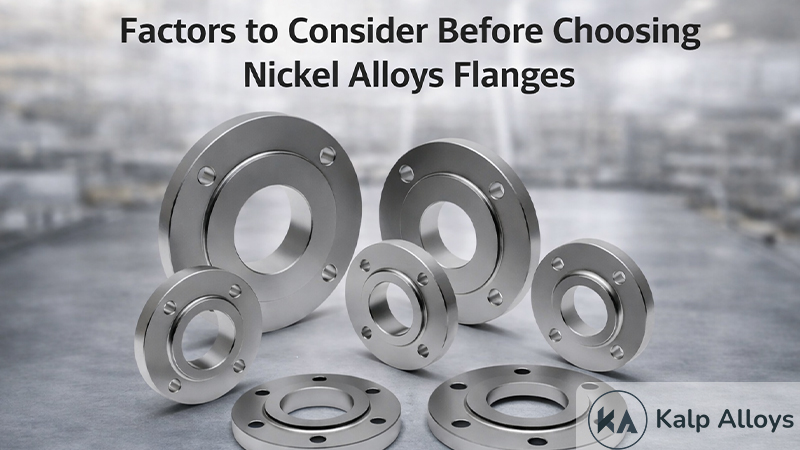
Nickel Alloys Flanges serve as rock-solid connectors within piping networks and are designed from nickel-based superalloys – i.e. they ‘tough out’ situations where regular metals would fail or start to degrade. These flanges are specifically formulated from a combination of high nickel content mixed with chromium, iron, molybdenum and copper – essentially endowing them with an unequalled resistance to acids, alkalis, seawater and oxidation that can reach temperatures of over 1000°C. We, as a leading Nickel Alloys Flanges Exporter, go about making them use precision forging and machining to get leak-proof seals in extremely demanding situations.
These unique flanges, which can endure the rigors of heat cycling and exposure to some of the most abrasive chemicals available, are especially important to plants in the chemical processing and oil and gas industries. You’ve got grades like Hastelloy C276 that resist pitting in streams with lots of chloride in them and Inconel 625 that stays strong in high pressure sour gas lines. It really is no surprise that nickel alloys flanges are considered a go-to choice when it comes to making safety-critical joints.
Corrosion Resistance has got to be the top factor here
Corrosion dictates the lifespan of flanges in harsh environments – which is where nickel alloys flanges really shine with alloy chemistry tailored to the specific hazard. Hastelloy variants , for example, resist hydrochloric and sulfuric acids which are so common in petrochemical scrubbers – and can be devastating on carbon steel when the pH levels get out of whack. Monel 400 can battle seawater corrosion in offshore platforms and prevent biofouling and galvanic decay over decades.
Before you order – take a close look at what your media is – for example, if you ‘ve got oxidizing acids you’ll want to go for Inconel 600 and its chromium shield; if you ‘ve got reducing conditions then Incoloy 825 has got a molybdenum addition that prevents crevice attack. We at Kalp Alloys put every single batch through a rigorous test for uniform microstructure and make sure they meet NACE MR0175 standards for sour service. If you don’t and your micro-cracks start to propagate – you’re looking at sudden breaches.
Temperature and Pressure Ratings – No Problem
High temperatures demand alloys that can keep their strength and not ‘lose it’ from embrittlement – and nickel alloys flanges are up to the task here , performing at temperatures up to 1100°C. Inconel 718 keeps its tensile strength in gas turbines at exhaust temperatures and Hastelloy X can withstand furnace manifolds at 1200°C. As for pressure classes – from Class 150 to 2500 it comes down to wall thickness; Class 900 Incoloy flanges can keep a 24-inch line at 1500 psi from deforming.
Match ratings to ASME B16.5 tables—oversize for safety margins in cyclic operations like heat exchangers. As a reliable Nickel Alloys Flanges Manufacturer, Kalp Alloys supplies these across ½” NB to 48” NB, calibrated for your system’s design pressure and thermal expansion.
Alloy Grades and Their Ideal Uses
- Hastelloy for Aggressive Chemicals: Hastelloy C22 and C276 flanges dominate in flue gas desulfurization, resisting mixed acids and chlorides that pit lesser alloys. Their low carbon content curbs weld sensitization, perfect for fabricated spools in pollution control.
- Monel for Marine and Acid Services: Monel 400 and K500 offer seawater resistance plus precipitation hardening for high-strength bolting in subsea tiebacks. K500’s age-hardening boosts fatigue life in pump flanges under pulsating flows.
- Inconel for Extreme Heat: Inconel 600, 625, and 718 handle aerospace ducting and nuclear reactors, where oxidation scales form protective layers. 625’s niobium stabilizes against knife-line attack post-welding.
- Incoloy for Thermal Stability: Incoloy 800, 800H, and 825 stabilize at 900°C in carburizing furnaces, resisting nitriding and sigma phase embrittlement. Ideal for ethylene crackers and reformers.
Kalp Alloys stocks these grades as a premier Nickel Alloys Flanges Exporter, with full traceability from melt to finish.
Flange Types and Application Fit
Weld neck flanges provide hub reinforcement for high-stress roots in compressor stations—Inconel versions excel here. Slip-on and socket weld save weight in marine risers, where Monel counters cavitation erosion. Blind flanges cap hydrotests ends, Hastelloy for corrosive hydrostatics.
Threaded flanges suit instrument tees without hot work, while lap joint pairs with aligned stubs for bolt access in catalyst beds. Select per ASME B16.47 for giants over 24 inches, prioritizing full-face gaskets in vibrating zones.
Manufacturing Standards and Testing
ASME B16.5 governs facing and bolting up to 24 inches, B16.47 beyond—Kalp Alloys complies fully. ASTM specs dictate chemistry; forging follows normalized and tempered protocols to refine grains. Ultrasonic testing detects laminations, magnetic particle checks surface flaws.
Demand PMI verification for alloy identity, hardness per grade minima, and impact toughness for cryogenic risks. Surface finishes—polished for hygiene, machined for gasket seating—impact leak rates.
Common Pitfalls in Selection
Mismatching alloy to media invites selective leaching—test coupons first. Overlooking galvanic couples with dissimilar metals accelerates anode dissolution; isolate with insulators. Underestimating weld consumables leads to dilution zones prone to cracking.
Skipping post-weld heat treatment in 718 softens precipitates, dropping rupture strength. Source from vetted Nickel Alloys Flanges Manufacturer like Kalp Alloys to dodge counterfeits plaguing spot markets.
Applications Across Industries
Chemical plants deploy Hastelloy in phosgene lines, Monel in acetic acid towers. In the face of CO2 floods, oil and gas prefer Inconel 625 for subsea manifolds. Marine sectors trust Monel in desalination plants, aerospace Inconel in afterburners. Power generation uses Incoloy 800H in superheaters, petrochemicals Hastelloy C276 in alkylation units. These prove nickel alloys flanges indispensable where failure costs skyrocket.
Why Choose Us
Kalp Alloys stands as a trusted supplier of high-quality ferrous and non-ferrous metal products designed for diverse industrial applications. With a strong focus on precision, performance, and customer satisfaction, we offer a wide range of materials, strict quality control, and reliable delivery. Our experienced team provides every requirement with the right solution, supported by customized specifications and timely service. Whether your project demands Stainless steel, Carbon steel, Alloy Steel, Duplex and Super Duplex, Nickel Alloys, Titanium, Copper, Aluminium and other advanced alloy materials, Kalp Alloys delivers dependable products and expert support to help you achieve consistent, long-lasting results across all applications.
Conclusion
Smart nickel alloy flange options for chemical, oil and gas, and marine applications are determined by important parameters such as corrosion resistance, temperature-pressure ratings, alloy grades (Hastelloy, Monel, Inconel, and Incoloy), flange types, an, and power plants. Prioritize Hastelloy for acids, Inconel for heat, and ASME-tested quality to forge unbreakable joints that outlast extremes. Your operations gain unmatched durability and peace of mind.
For tailored advice on Nickel Alloys Flanges Manufacturer or Nickel Alloys Flanges Exporter options linked to “Factors to Consider Before Choosing Nickel Alloys Flanges,” call +91 8160873937 or email info@kalpalloys.com.
FAQs
What size range do nickel alloys flanges come in?
½” NB to 48” NB covers all piping from instruments to mains.
Which alloy suits seawater applications?
Monel 400/500 resists marine corrosion effectively.
Are nickel alloys flanges ASME compliant?
Yes, to B16.5, B16.47, and ASTM standards for reliability.
What industries use Incoloy flanges?
Petrochemical heat exchangers and furnace components.
How to reach Nickel Alloys Flanges Manufacturer Kalp Alloys?
Dial +91 8160873937 or email info@kalpalloys.com.